African AI Founders Reshaping Global Innovation Landscape
Discover how African AI founders like Karim Beguir, Karim Jouini, and Pelonomi Moiloa are building the next wave of AI infrastructure and solutions globally.

Africa's AI revolution has entered a new chapter. While Western tech giants capture headlines with their trillion-dollar bets, a generation of African founders is quietly building the infrastructure and solutions that will define the next wave of artificial intelligence.
From optical chips powering data centers to language models that finally understand African voices, these entrepreneurs are proving that world-class AI doesn't have to be built in Silicon Valley. They're building it in Cairo, Johannesburg, and Tunis. And they're winning global recognition while doing it.
Over 2,400 African startups are now building AI infrastructure or leveraging it to engineer their own solutions, according to recent industry reports. But what distinguishes the current moment is not just the number of startups, it's the caliber of founders and the scope of their ambitions.
These aren't companies chasing hype. They're solving real problems that global leaders overlooked, and they're attracting serious capital from Microsoft, Google, MediaTek, and BioNTech. This is the story of how Africa's AI founders are changing the conversation.
The InstaDeep Blueprint: From Tataouine to a Billion-Dollar Acquisition
The most defining moment for African AI came in 2023 when BioNTech acquired InstaDeep for approximately 680 million dollars, marking one of the largest tech exits from the continent. But the real story isn't the acquisition price. It's the journey that led there.
Karim Beguir, co-founder and CEO of InstaDeep, started his journey in an unlikely place: Tataouine, Tunisia—the same desert town that inspired Star Wars. With limited resources but unbounded ambition, Beguir built a company that developed decision-making systems powered by reinforcement learning.
Unlike typical AI startups chasing chatbots and language models, InstaDeep solved actual problems in biotech, logistics, and energy optimization.
Beguir's vision was radical: prove that world-class AI research could happen on the African continent, with African teams, serving global enterprises.
By 2021, InstaDeep was presenting five research papers at NeurIPS (the world's most influential AI conference), including work from Tunisia-based researchers Rihab Gorsane and Omayma Mahjoub, the first African women to lead NeurIPS papers. In 2024, Beguir was named to TIME's 100 most influential people in AI.
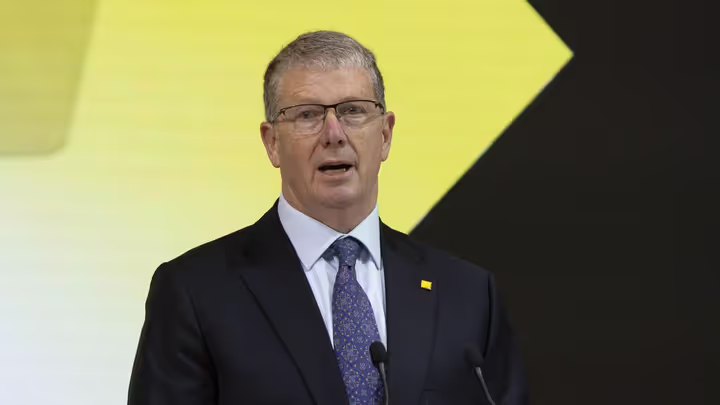
Today, even after the BioNTech acquisition, Beguir continues shaping Africa's AI landscape as an investor and mentor, backing emerging founders like Karim Jouini, whose new venture Thunder Code is already proving that lightning can strike twice.
The Second Act: Karim Jouini's Thunder Code and the Rise of Serial Founders
Karim Jouini and Jihed Othmani weren't supposed to start another company. After selling Expensya (their expense management platform) to Sweden's Medius for over 120 million dollars in 2023, they promised themselves they'd never do another startup. They'd built something successful. They'd cashed out. Game over.
But then they witnessed the generative AI revolution firsthand. Jouini, serving as Chief Product Officer at Medius, watched teams across three continents struggle with the same problem: how to automate software testing at scale.
The opportunity felt too massive to ignore. In June 2025, Thunder Code launched, and within six weeks had shipped a working MVP. Six months later, the platform was running in paying customers and pilot programs across the U.S., Canada, France, and Tunisia.
The seed round tells the story of Africa's emerging influence: 9 million dollars from Silicon Badia, Janngo Capital, Titan Seed Fund, and strategic angels including Karim Beguir (CEO of InstaDeep) and Roxanne Varza (Director of Station F). Former Expensya employees who benefited from the first acquisition also invested in the second.
"If we build a unicorn while diluting ourselves, that's good value," Jouini said, rejecting the typical African founder's fear of giving away equity. This pragmatism, combined with execution speed, is becoming the African AI playbook: ship fast, hire talent aggressively, and accept that dilation for speed beats control at a standstill.
The Silicon Photonics Revolution: Ahmed Aboul-Ella's InfiniLink
While Jouini focuses on software testing, Ahmed Aboul-Ella is tackling something far more fundamental: how to move data inside hyperscale AI data centers at the speed of light rather than electricity.
InfiniLink, founded in 2022, develops silicon-photonics optical transceiver chiplets designed to slash power consumption in AI data centers while boosting bandwidth. Traditional copper interconnects are hitting their limits as AI workloads explode.
Data centers now consume roughly 2 percent of global electricity, and with AI training demands growing 10x faster than infrastructure, the math becomes unsustainable. InfiniLink's photonic chips solve this by replacing electrical signals with light.
In March 2025, InfiniLink closed a 10 million dollar seed round led by MediaTek, the world's largest fabless semiconductor company. By November 2025, GlobalFoundries announced it had acquired InfiniLink—a watershed moment proving that deep-tech semiconductor innovation can now originate from Egypt and scale globally.
Aboul-Ella, who spent 23 years in the semiconductor industry before founding InfiniLink, represents a crucial shift: African founders with genuine deep-tech expertise, not just software skills. His team combines photonics engineering, analog mixed-signal design, and chip layout expertise; competencies that previously seemed impossible to attract to Africa.
The Language AI Maverick: Pelonomi Moiloa's Lelapa AI
While Western AI companies obsess over larger language models trained on ever-expanding datasets, Pelonomi Moiloa decided to go in the opposite direction. As CEO of Lelapa AI, based in Johannesburg, South Africa, she's building smaller, more efficient language models designed specifically for African languages.
The problem is staggering: Africa represents roughly one-third of the world's languages (1,000 to 2,000), yet most global AI systems treat African languages as invisible afterthoughts. ChatGPT struggles to understand Swahili. Google Translate mishandles Yoruba cultural context. The result: 520 million Africans are effectively excluded from the AI economy.
Lelapa's approach flips the script. Rather than training massive models on internet data, Moiloa's team works with linguists and local communities to build datasets rooted in cultural context. Their InkubaLM model, trained on Swahili, Yoruba, isiXhosa, Hausa, and isiZulu, has achieved a 75 percent size reduction through a global machine learning competition (the Buzuzu-Mavi Challenge), proving that smaller, smarter models can outperform the bloated alternatives.
Moiloa has been featured in TIME's 100 most influential people in AI and speaks regularly at global forums like the World Economic Forum. Her message is radical in its simplicity: if you want to go far, you must go together. Lelapa has raised 2.5 million dollars in backing from Mozilla Ventures, Atlantica Ventures, and investors including Google AI chief Jeff Dean and Karim Beguir.
Why This Moment Matters: The Four Themes Reshaping African AI
What unites Beguir, Jouini, Aboul-Ella, and Moiloa is not just talent—it's a pragmatic philosophy about how AI should be built in resource-constrained environments.
First, African founders are building vertical solutions. Rather than chasing horizontal platforms, they're solving deeply entrenched problems in regulated industries like finance, energy, and pharmaceuticals. Open Access Energy's EnergyPro helps manage electricity wheeling and grid forecasting. Salus Cloud builds DevOps platforms for Africa's booming SME software sector.
Second, they're developing culturally intelligent platforms. Lelapa's language models understand African names and places. InstaDeep's decision systems were trained on African-specific problems. These aren't Western tools with African tokenism attached.
Third, they're building picks-and-shovels infrastructure. Thunder Code automates testing. InfiniLink powers data center connectivity. They're creating the foundational layer that allows other startups to scale faster.
Finally, and most importantly, they're executing with ruthless speed and pragmatism. Thunder Code shipped its MVP in six weeks. InfiniLink went from concept to GlobalFoundries acquisition in three years. This is not the agonizing pace of traditional enterprise software. This is startup velocity applied to deep tech.
The Funding Shift: Global Capital Taking African AI Seriously
The numbers tell the story. Nigeria alone hosts over 400 AI firms and is Africa's second-largest player in the AI landscape as of 2024. Egypt received roughly 339 million dollars in startup funding in the first half of 2025. Tunisia's digital sector contributes 11 percent of GDP and hosts over 2,200 digital companies.
But more significantly, the type of capital flowing to African founders has changed. Five years ago, African AI funding came mostly from impact investors and government grants.
Today, strategic venture capital from Silicon Valley, MENA, and Asia is leading rounds. MediaTek backing InfiniLink. Google investing in Lelapa. InstaDeep founders acting as angels for Thunder Code. This isn't charity. It's global capital recognizing genuine competitive advantage.
The Reality Check: Challenges Remain Real
Of course, the narrative isn't all triumph. Africa's AI founders still face challenges that their Silicon Valley counterparts never encounter. Brain drain remains a constant threat. Infrastructure gaps slow hardware development. Access to compute remains expensive compared to U.S. data centers.
Additionally, the funding environment remains volatile. While 2024 and early 2025 saw robust capital flow to African AI, global funding cycles are unpredictable. Many African founders still report difficulty raising beyond seed stage without relocating to the U.S.
But here's what's different now: the founders aren't waiting for perfect conditions. They're building within constraints. They're shipping faster. And they're winning.
What Comes Next: The Inflection Point
Africa's AI moment is not coming. It's here. The conversation has shifted from "Will African startups build AI?" to "What will African AI startups build next?"
The founders reshaping this narrative are not doing it for headlines. They're doing it because the problems are real, the opportunities are massive, and they're the right people to solve them.
Karim Beguir proving that world-class AI research happens in Tunisia. Karim Jouini shipping ten times faster the second time. Ahmed Aboul-Ella building chips that power the future of data centers. Pelonomi Moiloa ensuring that 520 million Africans don't get left behind by AI.
These aren't isolated success stories. They're the vanguard of a movement. The next wave of global AI innovation will look different from the previous one. It will be faster, more pragmatic, more efficient, and unapologetically African. The world's investors have finally caught on. The question is no longer whether Africa will lead in AI. It's how quickly the continent can scale.
Fast Facts: African AI Founders Explained
Who are the leading African AI founders changing the global conversation?
Key figures include Karim Beguir (InstaDeep, acquired by BioNTech for 680 million), Karim Jouini (Thunder Code, 9 million seed round), Ahmed Aboul-Ella (InfiniLink, acquired by GlobalFoundries), and Pelonomi Moiloa (Lelapa AI, 2.5 million funding). They represent the new generation building infrastructure, language models, and decision-making systems that solve uniquely African problems at global scale.
What makes African AI founders different from their Western counterparts?
African AI founders prioritize pragmatism over hype, building within resource constraints rather than waiting for ideal conditions. They develop culturally intelligent solutions, ship at startup velocity, and focus on vertical problems in regulated industries. Their efficiency-first approach proves that world-class AI doesn't require unlimited compute or massive datasets—it requires smarter thinking.
What's the biggest challenge African AI founders still face?
Brain drain, infrastructure gaps, and inconsistent access to compute remain real obstacles. Funding beyond seed stage often requires relocating to the U.S., and global capital cycles remain unpredictable. However, the shift toward strategic venture investment from global tech giants signals that these challenges are becoming surmountable for founders with genuine solutions.