AI for Extreme Environment Robotics: Drones, Submersibles, and Space Exploration
Discover how AI-powered robots are revolutionizing exploration in extreme environments. From autonomous underwater vehicles diving 6,000+ meters to Mars rovers operating independently, learn how AI enables machines to survive and thrive where humans cannot.

In 2025, Mars rovers are discovering signs of ancient water while unmanned submersibles dive beyond 8,000 meters into Earth's least-explored frontiers. Simultaneously, drone swarms coordinate across the harsh Arctic and above volcanic craters on distant moons.
Yet none of these achievements would be possible without a critical shift that artificial intelligence has transformed robotics from remote-controlled tools into truly autonomous explorers.
The robots no longer need constant human guidance to survive in the harshest environments our planet and solar system have to offer.
This transformation marks a turning point in exploration itself. For the first time, machines can make intelligent decisions, navigate treacherous terrain, and adapt to unpredictable conditions without waiting for commands from Earth.
The global aerospace robotics market reflects this momentum, projected to expand from $32.5 billion in 2024 to $67.9 billion by 2034, with space-based AI systems emerging as the fastest-growing segment at 10.4% compound annual growth.
The Three Frontiers: Where AI Robots Excel
Extreme environment robotics operates across three distinct domains, each presenting unique challenges that AI is uniquely suited to solve.
The first frontier is underwater exploration. The global underwater drones market has exploded from $5.1 billion in 2024 to a projected $16.7 billion by 2034, representing 12.8% annual growth. Autonomous underwater vehicles (AUVs) equipped with AI now dive to depths exceeding 6,000 meters without tethers, operating independently for hours while making real-time decisions about navigation and data collection.
These machines are discovering thousands of new marine species annually, revealing bioluminescent ecosystems that remained invisible to humans until AI-guided submersibles arrived with precision LED lighting and computer vision systems.
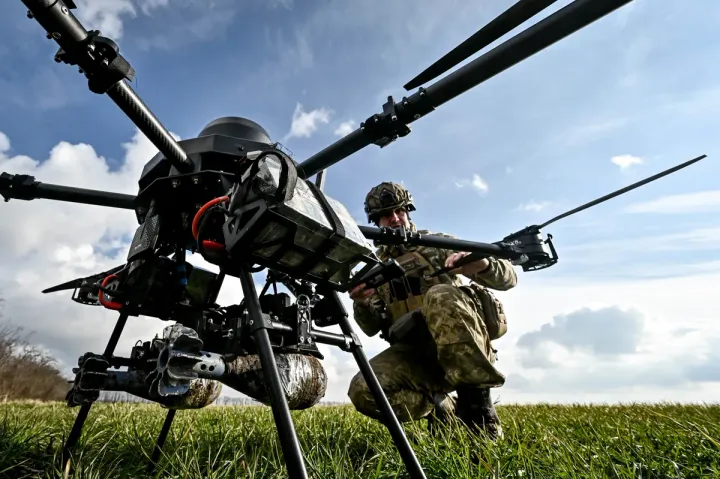
The second frontier is aerial robotics. AI-powered drones navigate extreme weather conditions, volcanic environments, and Arctic terrain with precision that exceeds human pilot capability. These systems process environmental data in real-time, adjusting flight patterns dynamically while mapping terrain, collecting atmospheric samples, or monitoring scientific instruments in conditions humans cannot survive.
The third frontier is space exploration. NASA and private space companies allocated $10 billion in 2025 specifically for AI-based space development. Rovers on Mars operate autonomously for weeks between communications windows, using AI to navigate rocky terrain, diagnose equipment failures, and prioritize scientific tasks without waiting for instructions from Earth.
The latency problem alone makes human control impossible: Mars rover communications experience delays between 21 to 23 minutes each way.
The AI Brain: How Machines Think in the Unknown
What fundamentally changed is autonomy depth. Early robots received programmed instructions and followed them blindly. Modern AI-powered robots understand their environment, recognize anomalies, and make contextual decisions.
An underwater robot hunting for marine debris provides a concrete example. The Technical University of Munich developed a submersible equipped with AI systems trained on 7,000 labeled underwater images. When it encounters an object, its AI transforms 2D camera footage into precise 3D models, analyzes whether the object is fragile, and calculates the optimal grip pressure.
Its four-fingered gripper can exert up to 4,000 Newtons of force yet delicately lift objects without crushing them. This isn't programmed behavior; it's learned intelligence adapting to real-world conditions.
Space robotics demonstrates even more sophisticated autonomy. Quantum-enabled AI systems combined with edge computing reduce mission failures by 40% by enabling unmanned vehicles to make critical adjustments during deep space operations without Earth-bound operators.
These systems operate on principles humans cannot fully explain, optimizing performance at levels that transcend traditional rule-based programming.
The Deep Sea Revolution: Exploring Earth's Final Frontier
Consider the E/V Nautilus, a research vessel that streams remotely operated vehicle (ROV) dives live on NautilusLive.org. In 2024, high school students in San Diego conducted the first student-to-student videoconference with researchers piloting ROVs 4,500 meters below the surface, democratizing ocean science in real-time. This represents a fundamental shift: exploration is no longer exclusive to government agencies.
Underwater gliders exemplify AI efficiency. These AUVs don't use thrusters at all. Instead, they adjust buoyancy to rise and sink, using wing-like fins to glide horizontally through the water column. Some models can patrol the ocean for months collecting temperature, salinity, and pressure data across thousands of square kilometers while consuming minimal power.
Saildrone's Explorer unmanned surface vessels boast over 12 months of endurance, recently mapping 90,000 square kilometers of deep water in the Cayman Islands in work that would have required years of ship time at exponentially higher costs.
Yet this technological leap masks a darker reality. The same AI-guided submersibles enabling scientific discovery also enable destructive deep-sea mining. Mining vehicles crush seafloor sediments and polymetallic nodules, obliterating habitats that support creatures adapted to stable conditions over millions of years.
In 2025, the UN approved China's Global Hadal Exploration Program, bringing together institutions from over 10 countries, while Europe's €9 million MiningImpact3 project develops "traffic light" threshold systems to detect when mining risks ecosystem damage. The technology is revolutionary; how humanity chooses to deploy it remains uncertain.
Space: Building Tomorrow's Colonies
NASA's Artemis program aims to return humans to the lunar surface by decade's end, but robots will arrive first and stay far longer. AI-powered robots will conduct site preparation, habitat construction, and equipment maintenance in environments where humans can survive only in pressurized suits.
China's full-depth submersible Fendouzhe (Striver) demonstrated capabilities exceeding comparable American systems by descending beyond 8,000 meters to conduct in-situ experiments. This same capability translates to space: robotic systems now perform autonomous construction tasks on other worlds.
Swarm construction represents the next evolution, where collaborative robotic systems build extensive lunar and Martian habitats autonomously. Orbital maintenance robots will service and upgrade satellites, extending infrastructure lifespan and reducing costly human missions.
One often-overlooked advantage: AI robots don't suffer psychological effects from extended isolation. Mars-500 analog missions showed humans required extensive psychological preparation for long-duration space activities. Robots require only energy and maintenance, making them ideal for multi-year missions beyond Earth orbit.
The Limitations Reality Demands
Despite revolutionary capability, extreme environment robotics faces genuine constraints. Communication delays in space make true autonomous decision-making essential but risky. A rover making a catastrophic error on Mars cannot be rescued.
Energy remains a fundamental challenge. Battery technology limits AUV mission duration despite advances in efficiency. Deep-sea mining concerns highlight how advanced technology doesn't solve ethical questions, merely enables new dimensions of choice.
Hardware costs remain prohibitive. Building robots capable of surviving crushing ocean depths or extreme temperature fluctuations requires exotic materials and precision engineering. The aerospace robotics industry remains dominated by North America with 34.5% of the global market share, reflecting the capital intensity and technical expertise barriers to entry.
Human-robot collaboration presents ongoing challenges. Researchers emphasize that human oversight remains irreplaceable, especially for anomaly detection in unstructured environments. The future belongs not to pure automation but to human-robot teams, with machines handling hazardous work while humans provide judgment and oversight.
The Unfolding Future
By 2032, the space robotics market alone approaches $7.5 billion. Yet market projections obscure the actual significance: AI-powered extreme environment robots are becoming our primary explorers. They're searching for life in Earth's deep oceans and potentially discovering it in the subsurface oceans of Europa and Enceladus. They're building the infrastructure that will enable human presence beyond Earth.
The robots don't need oxygen, don't suffer from cold or darkness, and don't require rescue missions. They represent an entirely new category of explorer, one that thinks, adapts, and persists in conditions that would destroy any biological organism.
For scientists, investors, and explorers, the question is no longer whether AI robots can survive extreme environments. It's how quickly humanity can develop the infrastructure, funding, and international agreements to deploy them responsibly across every frontier that matters.
The age of human-guided robotics is ending. The age of intelligent machines exploring the unknown on their own terms is just beginning.
Fast Facts: AI Extreme Environment Robotics Explained
What are autonomous underwater vehicles, and how do they differ from remotely operated vehicles?
Autonomous underwater vehicles (AUVs) operate independently without tethers, using AI to navigate and complete pre-programmed missions autonomously. Remotely operated vehicles (ROVs) require constant human control via cables. AUVs can dive deeper, operate longer, and make intelligent decisions about navigation without human operators managing every movement in real-time.
How does AI enable robots to make survival decisions in extreme environments like the deep ocean or Mars?
AI systems leverage computer vision, machine learning, and edge computing to process environmental data instantly without waiting for human commands. Underwater robots with vision-trained AI can identify objects in near-darkness and adjust gripper pressure accordingly. Space robots use quantum-enabled AI to adapt to unpredictable terrain and complete scientific tasks during communication latency windows impossible for human teleoperation.
What are the major limitations preventing robots from completely replacing human exploration in extreme environments?
High development costs, battery limitations restricting mission duration, and ethical deployment challenges remain significant. Humans excel at anomaly detection and judgment in unstructured situations that confound AI. Most experts agree the future belongs to human-robot collaboration, where machines handle hazardous tasks while humans provide critical oversight and decision-making authority.