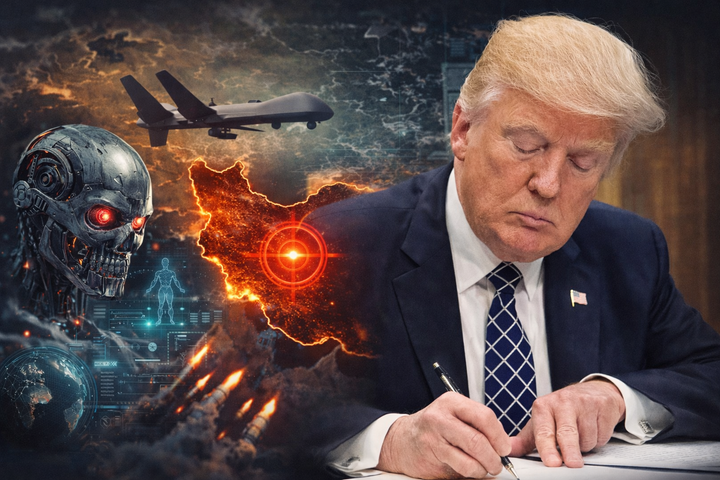
Algorithmic Battlefields: How AI Is Transforming Warfare From Supply Lines to Strike Decisions
AI is rewriting the rules of modern warfare, reshaping logistics, intelligence, and target prediction while raising urgent ethical and strategic questions for global security.

Modern warfare is undergoing its most profound transformation since the advent of nuclear weapons. Artificial intelligence has moved from experimental military labs into active operations, reshaping how armed forces plan, move, and fight. Unlike previous technologies that enhanced firepower, AI alters decision-making itself.
From predicting equipment failures to analyzing battlefield data in real time, AI systems are accelerating the pace of conflict. This shift is not theoretical. It is already influencing how militaries manage logistics, gather intelligence, and identify targets. The implications extend far beyond the battlefield, affecting global stability, ethics, and the future of deterrence.
Logistics becomes a predictive system
Military logistics has always been decisive. Armies that move faster, supply better, and adapt quicker gain a strategic edge. AI is turning logistics into a predictive discipline rather than a reactive one.
Machine learning models analyze vast datasets on fuel consumption, maintenance records, weather patterns, and troop movements. These systems can forecast supply shortages, predict equipment failure, and optimize transport routes before problems occur.
In conflict zones where delays can cost lives, predictive logistics reduces uncertainty. Autonomous systems can prioritize repairs, allocate resources dynamically, and minimize human exposure in dangerous supply operations. This quiet transformation often receives less attention than weapons systems, yet it may be AI’s most immediate military advantage.
Intelligence analysis at machine speed
Intelligence gathering has expanded dramatically with drones, satellites, sensors, and cyber surveillance producing constant streams of data. Human analysts cannot process this volume alone.
AI excels at pattern recognition across images, signals, and text. Computer vision systems detect changes in terrain or infrastructure. Natural language models scan communications for emerging threats. Anomaly detection algorithms flag unusual activity that warrants human attention.
This does not replace analysts. It changes their role. Instead of searching for signals, they interpret AI-curated insights. The speed advantage is significant. Decisions that once took days can now occur in minutes, compressing the decision cycle of modern warfare.
Target prediction and the automation dilemma
Target prediction represents the most controversial use of military AI. Predictive models assess behavior patterns, movement data, and historical activity to estimate where and when threats may emerge.
In theory, this improves precision and reduces collateral damage. In practice, it raises serious risks. Predictions are probabilistic, not certain. Errors in data or assumptions can lead to catastrophic outcomes.
The concern intensifies as AI systems move closer to autonomous decision-making. Even when humans remain in the loop, reliance on algorithmic recommendations can create automation bias, where operators trust systems more than their own judgment.
This tension sits at the heart of debates around lethal autonomous weapons. Efficiency and speed collide with accountability and moral responsibility.
Cyber and information warfare amplified by AI
AI is also reshaping non-kinetic warfare. In cyber operations, machine learning automates vulnerability discovery, intrusion detection, and adaptive defense. Offensive cyber tools can evolve rapidly, probing systems at machine speed.
Information warfare has become even more complex. AI-generated content enables rapid disinformation campaigns tailored to specific audiences. At the same time, defensive AI systems work to detect manipulation and protect information integrity.
This creates a feedback loop. As AI strengthens offense, it also becomes essential for defense. The digital battlefield is now as critical as the physical one.
Ethical, legal, and strategic consequences
The integration of AI into warfare raises questions that existing frameworks struggle to answer. International humanitarian law was designed for human decision-makers, not algorithmic systems.
Accountability remains unclear. If an AI-assisted decision leads to civilian harm, responsibility may be diffused across developers, commanders, and operators. Transparency is limited by the complexity of models and classified systems.
There is also the risk of escalation. Faster decision cycles reduce time for deliberation and diplomacy. In high-stakes environments, automated responses could amplify miscalculations.
Global norms are emerging slowly, but technological deployment is moving faster than regulation. This gap represents one of the most pressing governance challenges of the AI era.
A strategic shift, not a technological add-on
AI is not simply another tool in the military arsenal. It changes how power is exercised. Nations with superior data infrastructure, talent, and integration capabilities may gain disproportionate advantages without increasing traditional force size.
This reshapes deterrence. Strength becomes less visible, embedded in algorithms and data flows rather than troop counts or hardware. As a result, misperception risks grow, making transparency and communication even more critical.
Conclusion: warfare enters the algorithmic age
AI is rewriting the rules of modern warfare by accelerating decisions, reshaping logistics, and redefining how threats are identified. The technology promises efficiency and precision, but it also introduces new vulnerabilities and ethical dilemmas.
The challenge ahead is not whether AI will be used in warfare, but how responsibly it will be governed. As algorithms increasingly shape life-and-death decisions, the future of conflict will depend as much on ethics and oversight as on innovation itself.
Fast Facts: How AI Is Rewriting the Rules of Modern Warfare Explained
What does it mean that AI is rewriting the rules of modern warfare?
AI is rewriting the rules of modern warfare by shifting military advantage toward data-driven decision-making in logistics, intelligence analysis, and operational planning.
How is AI used in military targeting and prediction?
AI supports targeting by analyzing patterns and predicting potential threats, helping commanders prioritize resources while keeping humans involved in final decisions.
What is the biggest risk of AI in warfare?
The biggest risk is over-reliance, where flawed data or automation bias could accelerate errors, escalate conflicts, and weaken accountability for military actions.