Amazon Piloting Cashierless Tech in Smaller Retail Formats
Amazon is testing its cashierless technology in compact retail stores, aiming to cut costs and scale faster. But can smaller formats finally make Just Walk Out a viable business model?
Is a store without a checkout line actually the future of retail, or just an expensive tech flex? Amazon is betting again on the former, but this time with a more grounded approach. The company is piloting cashierless technology in smaller retail formats, signaling a shift from ambition to practicality.
Why Amazon Is Scaling Down Its Cashierless Vision
After experimenting with larger Amazon Go stores, Amazon is now focusing on compact retail spaces. The reason is simple. Bigger stores came with higher operational costs, complex infrastructure, and scaling challenges.
Smaller stores offer tighter layouts, fewer products, and more predictable customer behavior. This makes the system easier to manage and potentially more cost-effective. The move reflects a shift toward making the technology commercially viable rather than just impressive.
How the Cashierless System Works
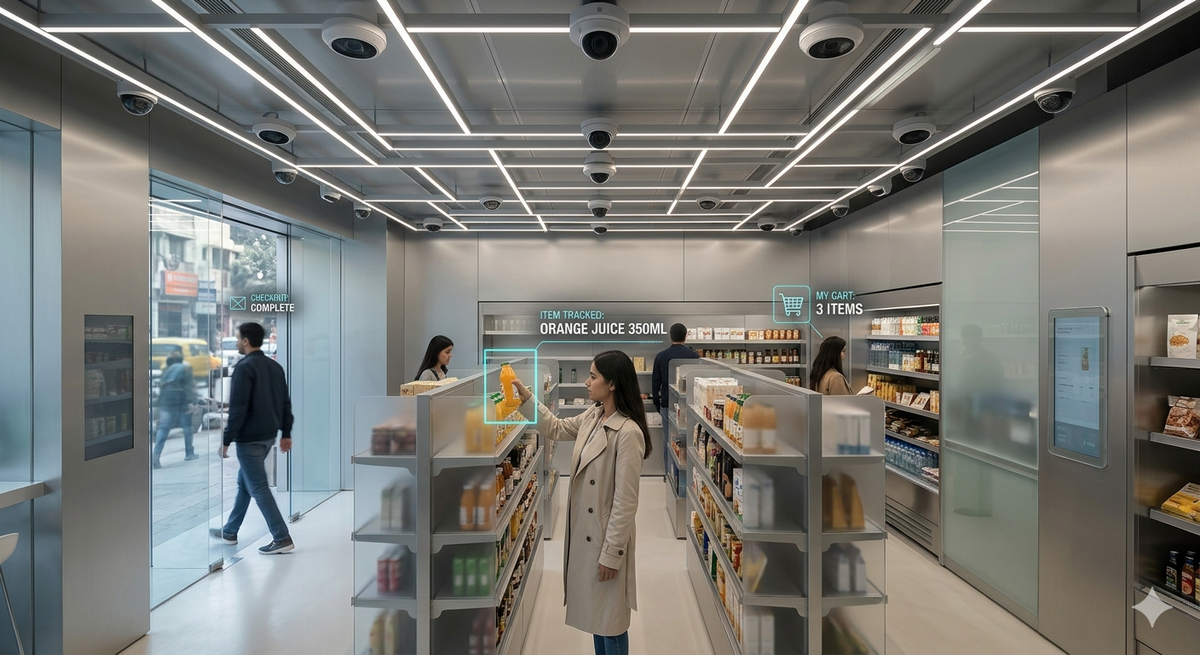
The system relies on a combination of computer vision, sensors, and machine learning. Cameras track customer movements, while shelf sensors detect when items are picked up or returned. These inputs are processed in real time to create a virtual cart.
Customers scan in, shop, and walk out. Payments are handled automatically through their accounts. Despite the automation, reports suggest that human oversight is still used in some cases to ensure accuracy.
Amazon Piloting Cashierless Tech in Smaller Retail Formats
This shift could address one of the biggest criticisms of the technology: cost inefficiency. Earlier implementations required heavy investment in hardware and maintenance. Smaller stores reduce these barriers.
There is also a strategic advantage. Compact cashierless stores can be placed in urban hubs, airports, and office spaces where speed matters more than product range. This aligns better with real-world consumer behavior.
The Trade-Offs: Privacy, Jobs, and Profitability
The model is not without concerns. Privacy advocates question the level of surveillance required to track every movement. Labor groups highlight the potential reduction in cashier jobs.
Profitability remains uncertain. Amazon has already scaled back some cashierless initiatives, indicating that the economics are still being tested. The technology works, but making it sustainable is a different challenge.
What This Means for Retail
This move reflects a broader trend in tech. Companies are shifting from bold experimentation to practical execution. Amazon’s smaller-format strategy suggests a more realistic path forward for cashierless retail.
If successful, it could redefine convenience shopping in high-traffic environments. If not, it will reinforce the idea that not all innovation scales easily. Either way, traditional checkout systems are not disappearing anytime soon.
Conclusion
Amazon’s latest approach feels less like a gamble and more like a correction. By focusing on smaller retail formats, the company is trying to turn a costly experiment into a scalable model.
The technology is proven. The business case is still under evaluation. That outcome will determine whether cashierless retail becomes mainstream or remains a niche concept.
Fast Facts: Amazon piloting cashierless tech in smaller retail formats Explained
What does Amazon piloting cashierless tech in smaller retail formats mean?
Amazon piloting cashierless tech in smaller retail formats means testing its Just Walk Out system in compact stores to reduce costs and improve scalability compared to larger locations.
Why is Amazon focusing on smaller stores?
Amazon piloting cashierless tech in smaller retail formats helps simplify operations, lower infrastructure costs, and better serve high-traffic areas where quick shopping is essential.
What are the main concerns with this technology?
Amazon piloting cashierless tech in smaller retail formats raises concerns about data privacy, job losses, and whether the system can become profitable at scale.