Amazon Piloting Drone Delivery Expansion in Dense Urban Areas Despite Regulatory Hurdles
Amazon is pushing drone delivery into crowded cities, testing whether speed, safety, and regulation can coexist in urban airspace. Here is what it means for logistics, consumers, and policymakers.
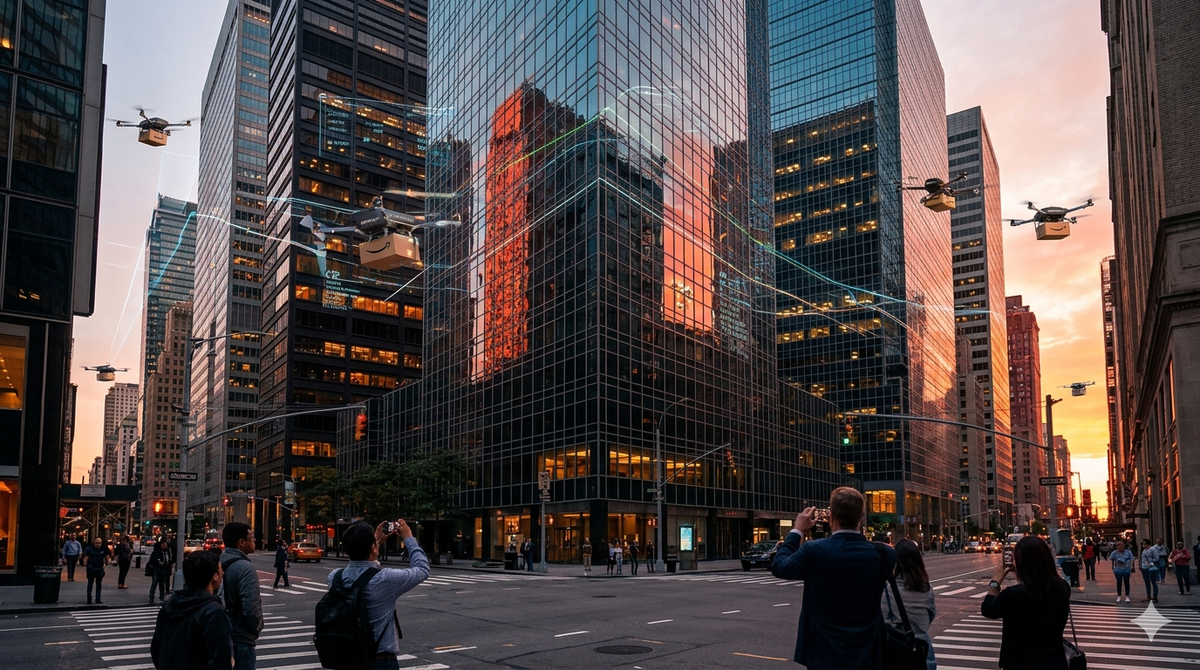
What happens when the sky becomes the next delivery lane? Amazon is pushing that idea into reality by testing drone deliveries in dense urban areas, where complexity is high and margins for error are low. The move signals a major shift in how goods could move through cities, if it works.
Why Amazon Is Moving Drone Delivery Into Cities
Amazon’s Prime Air initiative has spent years refining drone delivery in less crowded environments. Now the company is targeting cities, where order volumes are highest and delivery efficiency matters most. Urban logistics is expensive, with last-mile delivery accounting for more than half of total shipping costs in e-commerce.
By using drones, Amazon aims to cut delivery times to under 30 minutes for small packages. The appeal is obvious: faster service for customers and lower operational costs for the company.
Amazon Piloting Drone Delivery Expansion in Dense Urban Areas Despite Regulatory Hurdles
Urban airspace is tightly regulated and already busy. Aviation authorities enforce strict rules on drone operations, especially for flights beyond visual line of sight. Safety, air traffic integration, and noise compliance are major concerns.
Amazon is working through pilot programs to demonstrate that its drones can operate safely in crowded environments. Progress depends heavily on regulatory approval, which varies by country and remains slow. Public skepticism around privacy and constant aerial activity adds another layer of resistance.
The Technology Behind the System
Amazon’s drones use artificial intelligence to navigate complex environments. They combine sensors, cameras, and machine learning models to detect obstacles and adjust routes in real time.
The system can identify safe landing zones, avoid hazards like power lines and buildings, and cancel deliveries if conditions are unsafe. While effective in controlled tests, scaling this across unpredictable city environments remains a major challenge.
Potential Impact on Delivery and Urban Life
If successful, drone delivery could reshape urban logistics. Faster deliveries would improve customer satisfaction and set new expectations for speed. Reduced reliance on delivery vehicles could ease road congestion and lower emissions.
For businesses, especially small sellers, quicker fulfillment could lead to higher sales and better customer retention. The shift could also push competitors to accelerate their own automation strategies.
Concerns Around Safety, Jobs, and Privacy
The expansion raises serious concerns. Noise pollution from frequent drone flights could affect urban living conditions. Privacy risks emerge as drones rely on cameras and sensors to navigate.
There is also the issue of job displacement. As automation increases, traditional delivery roles may decline. Regulators will need to balance innovation with economic and social stability.
Conclusion
Amazon piloting drone delivery expansion in dense urban areas despite regulatory hurdles reflects a larger transformation in logistics. The company is testing whether technology can overcome regulatory friction and public concern.
The outcome will shape how cities adapt to automation. If successful, drone delivery could become a standard part of urban infrastructure. If not, it will remain an ambitious experiment grounded by real-world limits.
Fast Facts: Amazon Piloting Drone Delivery Expansion in Dense Urban Areas Despite Regulatory Hurdles Explained
What is Amazon trying to achieve with drone delivery?
Amazon piloting drone delivery expansion in dense urban areas despite regulatory hurdles aims to deliver small packages within 30 minutes, reducing delivery costs and improving speed in high-demand city environments.
How advanced is the drone technology being used?
Amazon piloting drone delivery expansion in dense urban areas despite regulatory hurdles uses AI-driven drones with real-time navigation, obstacle detection, and automated landing systems designed for complex urban settings.
What are the biggest challenges facing this expansion?
Amazon piloting drone delivery expansion in dense urban areas despite regulatory hurdles faces strict regulations, safety concerns, noise issues, and the difficulty of navigating crowded city airspace reliably.