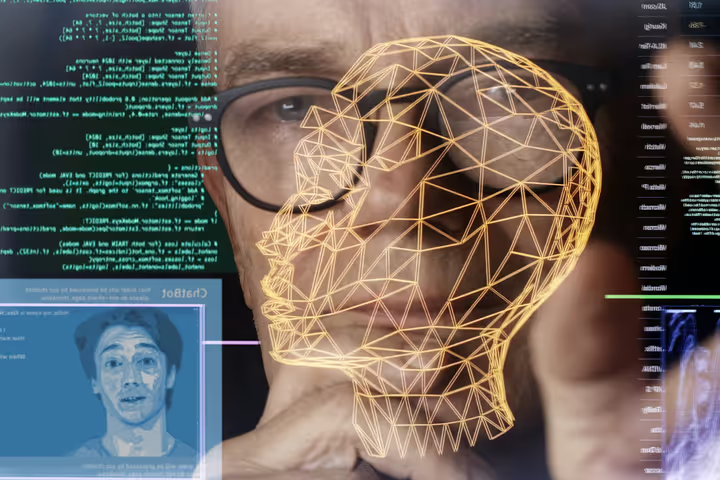
Democracy at the Crossroads: AI in Reshaping Global Elections and Demanding Urgent Policy Action
Explore how AI threatens election integrity through deepfakes and disinformation while offering opportunities to strengthen democracy. Discover the urgent policy debate reshaping global elections.

The 2024 election year was historic in more ways than one. Over 60 countries held national elections, representing nearly half the world's global population. But alongside the record voter turnout, another milestone emerged: this was the first election cycle where artificial intelligence played a widespread, visible role in shaping political discourse.
A deepfake audio of President Biden urged New Hampshire voters to skip the Democratic primary. AI-generated images of political candidates flooded social media. Synthetic content spread through WhatsApp and YouTube in elections across India, Brazil, and beyond.
The question is no longer whether AI will impact democratic processes. It already has. The urgent question is what policymakers will do about it.
The collision between rapid AI advancement and the fragility of electoral systems is creating a policy crisis. Experts at Harvard's Ash Center, the Brennan Center for Justice, and the Carnegie Endowment for International Peace agree on one fundamental assessment: without comprehensive policy action, the risks to democratic integrity will only accelerate.
Yet the guardrails protecting elections from AI misuse are already weakening just months after 2024. Voluntary commitments from technology companies are expiring. Political incentives to exploit AI are intensifying. And the threat environment is becoming less predictable precisely when it needs the most careful management.
The stakes could not be higher. Democracy depends on the ability of voters to make informed choices based on accurate information. AI threatens to obliterate that foundation. Understanding what's at stake and what policymakers must do is no longer a choice for concerned citizens. It's an imperative.
The Threats: Disinformation, Deepfakes, and Infrastructure Vulnerabilities
AI-generated disinformation operates at a scale and speed that fact-checkers cannot match. According to researchers, the capacity to generate misinformation now absolutely swamps the capacity of traditional fact-checking. This asymmetry creates a crisis of information integrity.
Deepfakes represent the most visible threat. These synthetic images, videos, and audio recordings can convincingly depict political candidates saying or doing things they never did. What makes deepfakes particularly dangerous is their emotional impact. They don't just spread facts or arguments. They viscerally convince people they've witnessed something happening.
A voter who sees a deepfake of a candidate accepting a bribe or making a racist statement may be swayed more by that fabricated image than by any counterargument or correction.
The 2024 cycle demonstrated the real-world danger. An AI-generated robocall impersonating President Biden told voters to "save" their votes for the general election, effectively suppressing turnout in the primary.
Reports from India's 2024 elections documented deepfakes showing celebrities endorsing opposition candidates. In Brazil, synthetic content was weaponized to spread false political narratives. While no direct impact on election outcomes has been definitively proven, the erosion of trust is measurable and cumulative.
The threat extends beyond voter perception to election infrastructure itself. AI-powered cyberattacks could target voting systems, registration databases, and election administration networks. AI can generate convincing fake evidence of ballot tampering or misconduct, fueling public distrust and potentially inspiring violence against election workers who already face unprecedented harassment.
Election administration itself becomes vulnerable. AI chatbots tested by security researchers produced inaccurate and misleading information about voting procedures, accessibility requirements, and polling locations. When voters seeking guidance encounter misinformation from AI systems, their ability to participate effectively diminishes.
The Opportunities: How AI Can Strengthen Democratic Processes
Yet the policy debate cannot focus solely on threats. AI also offers genuine opportunities to strengthen democracy if properly managed.
Election administration is computationally intensive and resource-constrained. AI can revamp electoral processes, making them more efficient and secure. Voter registration systems could leverage machine learning to prevent fraud while reducing barriers to legitimate voter participation.
Election officials could use AI to optimize poll site locations, manage volunteer scheduling, and improve accessibility for voters with disabilities.
Public participation in government decision-making has historically been time-consuming and expensive to sustain. AI offers tools to democratize this engagement at scale. Citizens could use AI-powered platforms to voice opinions, organize around shared priorities, and understand complex policy proposals.
Rather than relying on expensive consultants to process public comments on regulatory proposals, government agencies could deploy AI to systematically analyze feedback and identify genuine public sentiment.
Campaign communication could become more targeted and efficient. AI helps campaigns understand voter demographics and interests, enabling personalized messaging that reaches persuadable voters in swing districts. This efficiency could reduce the influence of money in politics by enabling smaller campaigns to compete more effectively.
The critical distinction is between AI that strengthens democracy and AI that undermines it. The same technology stacks create both opportunities and threats. The policy challenge is creating frameworks that amplify benefits while constraining harms.
The Policy Landscape: Fragmented Action and Expiring Safeguards
Global policymakers have begun responding, but their efforts remain fragmented and vulnerable to reversal.
The European Union approved the AI Act in May 2024, taking effect in 2026. It categorizes AI systems by risk level, imposing strict requirements on high-risk applications and banning extreme practices like cognitive behavioral manipulation. This represents the most comprehensive regulatory approach globally.
In the United States, 26 states have passed laws on AI and elections, mostly implemented in the last two years. The vast majority require transparency for deepfakes and synthetic media. Minnesota and Texas enacted full prohibitions on deceptive deepfakes. California mandated that large platforms develop detection capabilities for synthetic content.
The Brennan Center for Justice has called for federal legislation prohibiting knowingly distributing deepfakes with potential to suppress votes within 60 days of elections. The Center also urges strengthening robocall regulations and closing loopholes that allow political robocalls to landlines without consent.
Yet these safeguards face erosion. Voluntary commitments by technology companies, which helped contain AI misuse during 2024, are expiring. Leading AI companies have scaled back restrictions on political content.
OpenAI removed rules against disinformation from its usage policies, though it added new restrictions specifically against election interference. Anthropic similarly limited restrictions on political discourse while maintaining protections against deceptive content.
The danger is complacency. The fact that 2024 did not see widespread catastrophic outcomes from AI in elections should not suggest stability. It should suggest the relative success of interim safeguards that are now being dismantled.
As Harvard's Danielle Allen has emphasized, the question is not whether democracy can survive AI. It's how deliberately policymakers will design systems to ensure AI enhancement rather than replacement of human democratic judgment.
What Effective Policy Must Include
Experts converge on several policy imperatives.
Transparency requirements must be universal. Any AI-generated political content should be clearly labeled. Deepfakes should carry mandatory disclosures. This shifts the burden from voters trying to determine authenticity to creators being transparent about artificiality.
Regulatory clarity is essential. Currently, companies create their own standards. Establishing baseline requirements prevents a race to the bottom where platforms compete by being the most permissive. Federal legislation should define prohibited practices, establish accountability mechanisms, and create consequences for violations.
Election infrastructure must receive dedicated security resources. The Department of Homeland Security designated election systems as critical infrastructure, a necessary step. But funding and technical support remain inadequate. Election officials need access to AI-powered security tools and continuous adversarial testing to identify vulnerabilities before attackers do.
Education represents a foundational necessity. Voters need training in media literacy and AI literacy. Understanding how deepfakes work, recognizing manipulation tactics, and knowing how to verify information through trusted sources builds resilience against disinformation. This educational burden cannot fall on individuals alone. Government and platforms share responsibility.
International coordination is critical. AI-driven disinformation campaigns often originate beyond national borders. Election interference from foreign actors amplified by AI requires coordinated international responses. The UN's "AI for Good" initiatives and the emphasis on human rights standards in AI provide frameworks, but implementation remains nascent.
Finally, policymakers must center the voices of communities most vulnerable to AI misuse. Research shows Black and brown voters already face disproportionate targeting of disinformation. AI amplifies these existing inequities unless explicitly constrained. Any policy framework that doesn't address equity risks making democratic participation more unequal.
The Imperative: Act Now Before Precautions Erode
The 2024 election cycle provided a window into what AI-influenced electoral processes look like. The outcome was less catastrophic than some feared, but the underlying vulnerabilities remain. As AI tools become more sophisticated and actors become more willing to exploit them, the window for establishing robust safeguards narrows.
Policymakers face a choice. They can establish comprehensive frameworks now, when regulations can be crafted thoughtfully and stakeholder buy-in is achievable. Or they can wait, responding only after incidents occur, at which point damage control becomes the only option.
The relative calm of 2024 should not be mistaken for stability. The guardrails protecting elections are already weakening. Political incentives to exploit AI have intensified. The threat environment for 2026 and beyond is far less predictable than 2024.
Democracy depends on voters having access to accurate information and the ability to make authentic choices. AI threatens both. Policy must therefore do more than regulate AI in elections. It must center human agency, protect the integrity of information, and ensure that technology amplifies rather than replaces democratic judgment.
The time for deliberate, comprehensive action is now. The cost of waiting will be measured in eroded trust, disenfranchised voters, and the gradual displacement of human democratic processes by systems optimized for manipulation rather than genuine representation.
Fast Facts: AI's Role in Global Elections and Democratic Processes Explained
What are deepfakes, and how do they specifically threaten elections?
Deepfakes are synthetic media using AI to create realistic videos, images, or audio depicting people saying or doing things they never did. In elections, they threaten democratic integrity by spreading convincing disinformation about candidates, suppressing voter turnout through fraudulent messages, and eroding public trust in information during critical voting periods.
How can AI-generated disinformation actually influence voter behavior differently than traditional misinformation?
AI disinformation scales and spreads faster than humans can fact-check, creating an asymmetry where misinformation outpaces corrections. Deepfakes trigger emotional responses more powerfully than text. AI-targeted messaging segments voters by psychology, personalizing manipulation to individual vulnerabilities in ways traditional campaigns cannot replicate at scale.
What policy approaches are most effective for regulating AI in elections without stifling innovation?
Most effective policies combine transparency requirements for AI-generated content, baseline ethical standards across platforms, dedicated election infrastructure security funding, and voter education on media literacy. The EU AI Act and state-level deepfake regulations demonstrate that careful categorization by risk level allows beneficial applications while constraining harmful misuse effectively.