Economists Are Drawing Stronger Connections Between A.I. and Jobs
Is artificial intelligence quietly reshaping the global job market faster than we expected? A growing body of economic research suggests the answer is yes.
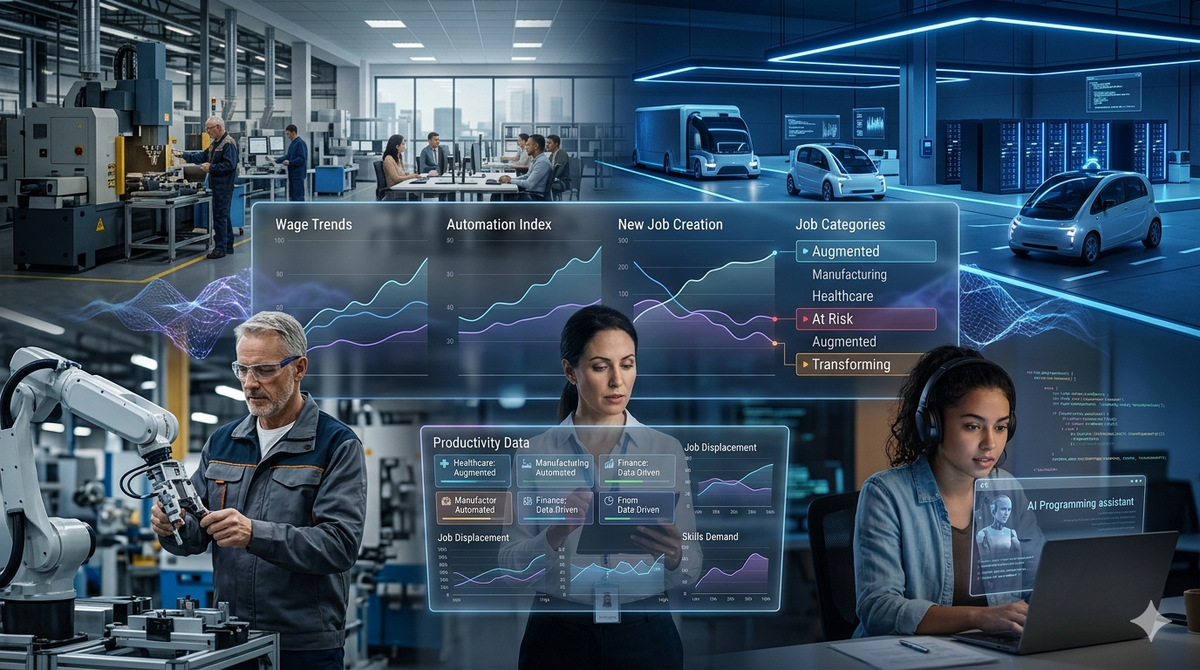
Is artificial intelligence quietly reshaping the global job market faster than expected? A growing body of research suggests it is. Economists are drawing stronger connections between A.I. and jobs, revealing not just disruption but a deeper structural shift in how work is created, performed, and valued.
From factory automation to generative AI in offices, the relationship between A.I. and employment is now measurable and increasingly urgent.
The Data Behind the Shift
Studies from institutions like the International Monetary Fund and MIT indicate that nearly 40 percent of global jobs are exposed to AI technologies. Exposure does not always mean replacement. In many cases, it means transformation.
Economists are drawing stronger connections between A.I. and jobs by tracking productivity gains, wage changes, and task-level automation. Research from MIT shows generative AI can improve productivity in writing and coding tasks by up to 40 percent, especially for less experienced workers.
This points to a more complex reality. AI is not simply removing jobs. It is reshaping them.
Economists Are Drawing Stronger Connections Between A.I. and Jobs in White-Collar Work
Automation was once seen as a threat mainly to manual labor. That view is outdated. Generative AI is now affecting roles in law, finance, marketing, and software development.
Economists are drawing stronger connections between A.I. and jobs in these sectors by examining how tasks like drafting reports, analyzing data, and customer interaction are being partially automated.
This is leading to hybrid roles where workers collaborate with AI systems. Digital skills and adaptability are becoming essential.
Winners, Losers, and Wage Gaps
The benefits of AI are uneven. High-skill workers who can use AI tools often see higher productivity and better wages. Roles that depend on repetitive cognitive tasks face greater risk.
According to the OECD, jobs involving routine tasks are more vulnerable to automation. This trend is widening the gap between workers who can use AI effectively and those who cannot.
Economists warn that without intervention, income inequality could grow. Upskilling is becoming an economic necessity.
Real-World Impact Across Industries
The effects are already visible. In healthcare, AI supports diagnostics and reduces administrative work. In retail, AI-driven systems improve inventory management and pricing. In media, generative tools accelerate content production.
Economists are drawing stronger connections between A.I. and jobs by mapping these changes across industries. The pattern shows AI enhancing high-value tasks while reducing repetitive ones.
Concerns remain. Job displacement, data privacy, and algorithmic bias require attention from policymakers and companies.
What This Means for the Future of Work
The debate is shifting from whether AI will take jobs to how jobs will evolve alongside AI.
Economists are drawing stronger connections between A.I. and jobs to guide policy and workforce strategies. Education systems are under pressure to prioritize skills such as critical thinking, creativity, and problem-solving.
The goal is not just growth, but inclusive growth that benefits a wider segment of society.
Conclusion
The link between artificial intelligence and employment is no longer theoretical. It is supported by data and visible across industries.
Economists are drawing stronger connections between A.I. and jobs to understand both opportunity and risk. The future of work will depend on how effectively humans adapt to working with intelligent systems.
Fast Facts: Economists Are Drawing Stronger Connections Between A.I. and Jobs Explained
What does it mean that economists are linking AI and jobs more closely?
Economists are drawing stronger connections between A.I. and jobs by studying how AI changes tasks, productivity, and wages, showing that work is being reshaped rather than simply replaced.
Is AI creating or eliminating jobs?
Economists find both effects happening, with AI creating new roles while reducing repetitive ones across industries.
What is the biggest concern about AI and employment?
Economists have highlighted inequality as a key risk, as workers without AI skills may face fewer opportunities and lower wages.