Evo 2 AI: Modeling the Genetic Code Across All Domains of Life
Scientists have built Evo 2 AI, a powerful model that can read and generate DNA across all forms of life, potentially transforming disease research, drug discovery, and synthetic biology.
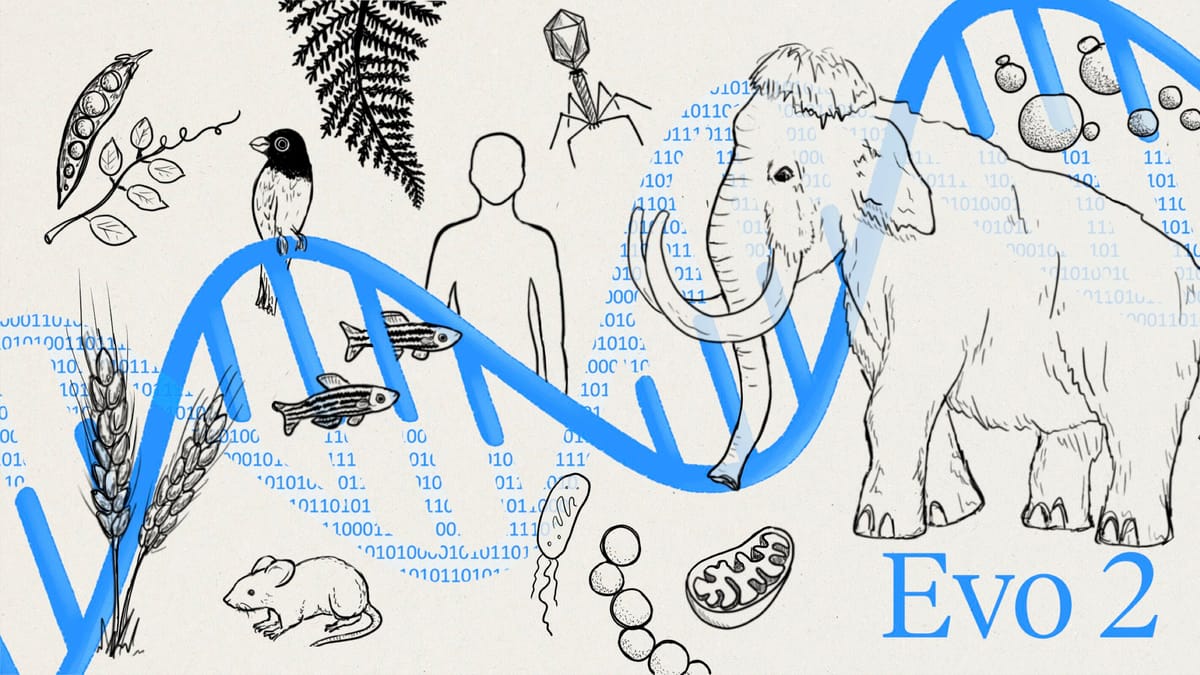
Artificial intelligence can now read and write DNA. But what if it could also design entire genomes?
A new DNA foundation model called Evo 2 AI is pushing the boundaries of biology and machine learning. Published in Nature, the model can analyze genetic patterns across the entire tree of life and even generate new genomic sequences. Researchers say this could accelerate everything from disease research to synthetic biology.
The breakthrough signals a new era where AI does not just interpret biology but actively participates in designing it.
What Is Evo 2 AI?
Evo 2 AI is a large-scale genomic foundation model designed to understand and generate DNA sequences across all domains of life.
Developed by scientists at Arc Institute in collaboration with NVIDIA, Stanford University, UC Berkeley, and UC San Francisco, the system was trained on more than 9.3 trillion nucleotides from over 128,000 genomes.
This includes genetic data from bacteria, archaea, plants, animals, and humans. The goal is similar to large language models but applied to biology. Instead of predicting the next word in a sentence, Evo 2 predicts the next nucleotide in a DNA sequence.
By learning evolutionary patterns embedded in genetic material, the system can detect relationships that might take researchers years to uncover through traditional experiments.
How Evo 2 AI Learns the Language of DNA
DNA contains instructions encoded through four nucleotides: A, T, C, and G. Evo 2 AI learns these patterns at massive scale.
During training, the model analyzed genome sequences and learned how different DNA regions interact, mutate, and influence biological functions. Its architecture can process long genetic sequences and capture complex genomic structures.
Researchers describe this capability as learning the “language of nucleotides.”
Evolution has spent billions of years refining these patterns. Evo 2 identifies and generalizes them across species, allowing scientists to study biology from microbes to humans in a unified framework.
Real-World Applications of Evo 2 AI
The practical implications of Evo 2 AI are substantial.
Predicting Disease Mutations
The model can identify genetic mutations that cause disease. In testing, it achieved over 90 percent accuracy in classifying BRCA1 gene variants, a gene strongly linked to breast and ovarian cancer.
This could help researchers rapidly evaluate genetic variants found in medical sequencing.
Designing Synthetic Genomes
Evo 2 AI can generate entirely new genetic sequences, including genomes as long as those of simple bacteria.
Potential applications include:
- Engineering microbes to produce medicines
- Designing biological sensors
- Creating environmentally useful organisms
Accelerating Biological Research
Researchers compare Evo 2 to a biological “operating system kernel.” Scientists can build specialized applications on top of it, such as tools for predicting protein functions or designing gene therapies.
Ethical and Safety Considerations
Like many powerful AI technologies, Evo 2 AI raises ethical concerns.
Genomic AI models could theoretically be misused to design harmful biological sequences. To mitigate risks, the research team intentionally excluded human-infecting pathogens from the training dataset and implemented safeguards to prevent harmful outputs.
Still, biosecurity experts emphasize that strong oversight and responsible governance will be necessary as generative biology advances.
The researchers also made Evo 2 open-source, sharing code, model weights, and training data with the scientific community to encourage transparency and collaborative oversight.
The Future of AI-Driven Biology
Evo 2 AI represents one of the largest biological AI systems ever built.
By combining massive genomic datasets with advanced machine learning, scientists now have a tool capable of analyzing evolution itself. More importantly, it enables researchers to design biological systems with unprecedented precision.
If used responsibly, genomic AI models like Evo 2 could accelerate drug discovery, improve genetic diagnostics, and unlock new forms of bioengineering.
The next decade may reveal a surprising reality. AI will not just help us understand life’s code. It may help us rewrite it.
Conclusion
Evo 2 AI marks a turning point in the convergence of artificial intelligence and biology. By training on trillions of DNA nucleotides across thousands of species, the system can identify disease-causing mutations, model evolutionary patterns, and generate new genetic sequences.
For scientists, it offers a powerful new tool. For society, it raises important ethical questions. Either way, the age of AI-driven genomic design has begun.
Fast Facts: Evo 2 AI Explained
What is Evo 2 AI?
Evo 2 AI is a genomic foundation model trained on trillions of DNA nucleotides. It learns patterns across species to understand and generate genetic sequences, helping scientists study evolution and predict disease mutations.
What can Evo 2 AI do?
Evo 2 AI can analyze genomes, identify harmful genetic mutations, and design synthetic DNA sequences. Researchers use Evo 2 AI to accelerate medical research, gene therapy development, and synthetic biology experiments.
Are there risks with Evo 2 AI?
Evo 2 AI raises biosecurity concerns because powerful genomic models could be misused. Developers of Evo 2 AI addressed this by excluding pathogen data and implementing safeguards to prevent harmful genetic design.