Google Testing AI-Generated Video Summaries Directly in Search Results
What if you never had to watch a 20-minute video just to find one useful insight? That is exactly the future Google seems to be testing.
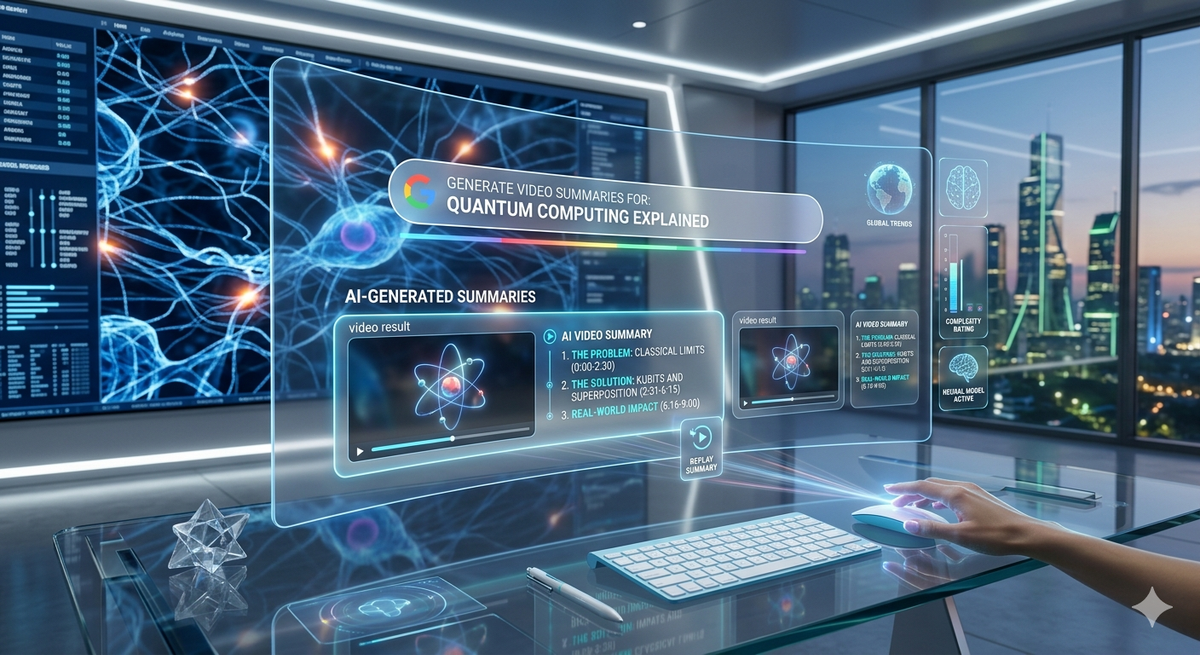
What if you never had to watch a 20-minute video just to find one useful insight? That is exactly what Google is experimenting with. The company is testing AI-generated video summaries directly in search results, allowing users to extract key insights without clicking or watching the full content.
This experiment builds on Google’s broader push into generative AI within Search. By combining advances in multimodal AI with its massive video index, Google is moving toward a future where answers are instant, curated, and increasingly detached from original content sources.
What AI-Generated Video Summaries Actually Do
The feature uses artificial intelligence to analyze video content, identify important segments, and generate concise summaries. Instead of navigating timestamps or watching entire videos, users are presented with structured highlights directly on the search results page.
These summaries are expected to pull from platforms like YouTube and present key points in text format. It mirrors how AI tools summarize articles but extends that capability to audiovisual content.
Why This Shift Matters for Search and Content
Video content has exploded in scale, with YouTube reporting more than 500 hours of video uploaded every minute. Finding relevant information within that volume is inefficient. AI summaries aim to solve this by reducing friction.
However, this convenience introduces a trade-off. If users get answers directly from summaries, they may skip watching the original video. This could reduce engagement, ad impressions, and overall revenue for creators.
The same pattern has already emerged with AI-generated answers replacing clicks to websites. Video may be next.
How the Technology Works
The system likely relies on multimodal AI models capable of processing both audio and visual inputs. These models transcribe speech, detect context, and identify key frames to generate meaningful summaries.
Google’s Gemini models have demonstrated this capability, showing strong performance in understanding video alongside text and images. This feature appears to be a direct application of that technology.
Accuracy remains a challenge. AI can misinterpret tone, miss nuance, or oversimplify complex topics, which raises concerns about reliability.
Opportunities for Users and Businesses
For users, the benefit is speed. Information becomes easier to access, especially for tutorials, reviews, and news content.
For businesses and creators, this introduces a new layer of optimization. Videos may need to be structured in a way that AI systems can easily extract key insights. Clear narration, logical flow, and concise messaging could become essential.
This shift may redefine video SEO, where ranking is influenced not just by engagement but also by how well AI can interpret the content.
Risks and Ethical Concerns
Creators face potential downsides. Reduced watch time can directly impact monetization. If summaries replace views, the economic model of video platforms could shift significantly.
There are also questions about ownership and fair use. Summarizing content without driving traffic back to the source raises concerns about value extraction.
Inaccurate summaries could also spread misinformation, especially if users rely on them without verifying the original content.
Conclusion
Google’s move signals a broader transition toward AI-driven information delivery. Speed and convenience are prioritized, but not without consequences.
For users, it simplifies discovery. For creators, it introduces uncertainty. The balance between accessibility and fair compensation will define how this feature evolves.
Fast Facts: Google Testing AI-Generated Video Summaries Directly in Search Results Explained
What is Google testing with AI video summaries?
Google testing AI-generated video summaries directly in search results allows users to see key insights from videos instantly without watching the full content.
How useful is this feature for everyday users?
Google testing AI-generated video summaries directly in search results helps users save time by quickly understanding video content across tutorials, reviews, and news.
What are the biggest concerns with this technology?
Google testing AI-generated video summaries directly in search results raises concerns about reduced creator revenue, accuracy issues, and questions around content ownership.