How China’s Humanoid Robots Stole the Spotlight This Lunar New Year
China’s humanoid robots wow Lunar New Year audiences, signaling AI ambition and raising global tech competition stakes.
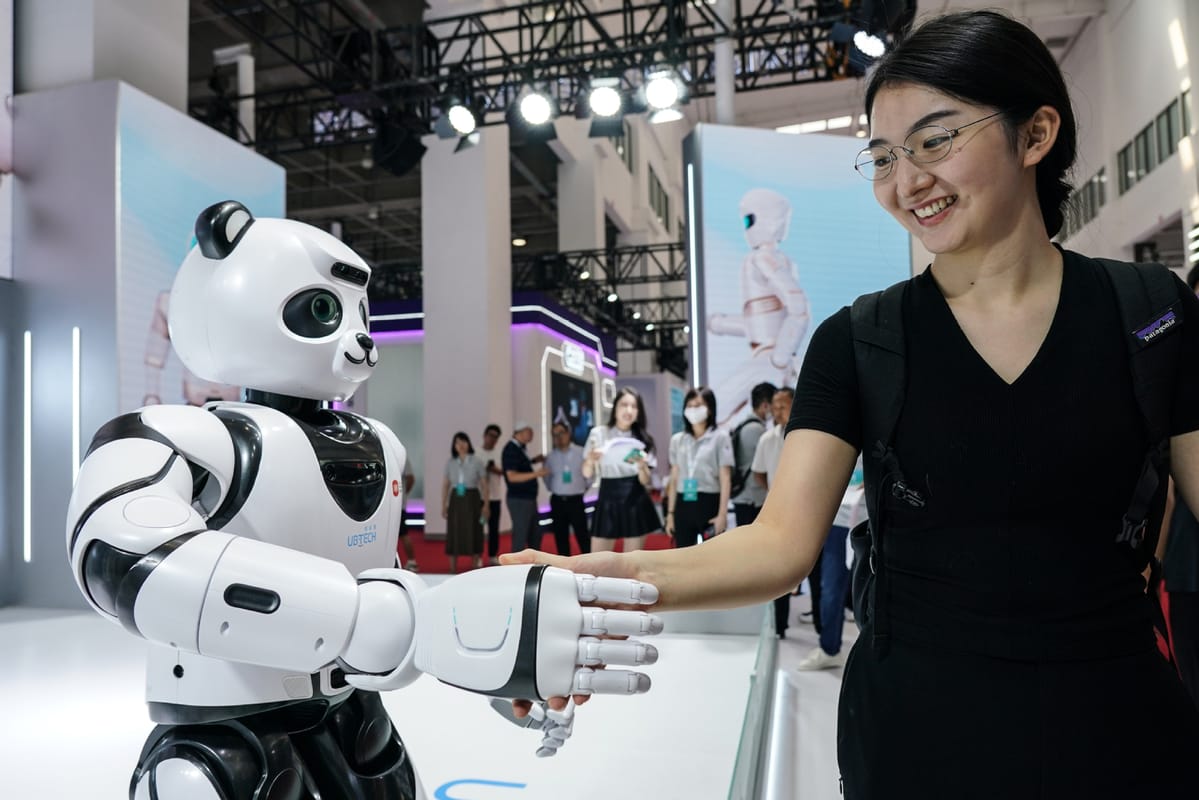
What happens when cutting-edge robotics meets the world’s largest annual celebration? This year, China’s humanoid robots provided the answer, stepping into the spotlight during Lunar New Year festivities and signaling a new phase in the country’s AI ambitions.
The showcase of China’s humanoid robots during high-profile performances was more than spectacle. It was a strategic statement about China’s growing capabilities in robotics, artificial intelligence, and advanced manufacturing. At a time when global competition in AI hardware is intensifying, these public demonstrations carry both cultural and geopolitical weight.
China’s Humanoid Robots and a National Tech Showcase
Lunar New Year galas attract hundreds of millions of viewers across China. Featuring humanoid robots in such a setting transforms robotics from a lab innovation into a household conversation.
China has prioritized robotics as a core industry. According to the International Federation of Robotics, China has led the world in annual industrial robot installations for several years. The country’s Ministry of Industry and Information Technology has also outlined plans to scale humanoid robot production and establish globally competitive supply chains by the mid-2020s.
By placing China’s humanoid robots on a mainstream stage, policymakers and tech firms are normalizing the technology while signaling confidence in domestic AI systems.
The Technology Behind the Performance
Humanoid robots designed for public performances rely on advanced motion control, computer vision, and AI-driven coordination. Companies such as UBTECH Robotics and Unitree Robotics have developed bipedal systems capable of synchronized movement, obstacle detection, and real-time balance adjustments.
Behind the scenes, these machines integrate large AI models for visual processing and motor planning. Advances in lightweight materials and high-torque actuators allow robots to perform fluid motions that were nearly impossible a decade ago.
Still, experts caution that performance robots operate in controlled environments. Real-world adaptability remains a major engineering challenge.
Strategic Significance in the Global AI Race
The rise of China’s humanoid robots aligns with Beijing’s broader AI strategy. Research institutions like Chinese Academy of Sciences have invested heavily in embodied AI, which integrates software intelligence with physical systems.
Globally, firms such as Tesla are also pushing humanoid platforms. Tesla’s Optimus robot aims to support factory automation. The difference is context. While US firms emphasize industrial use cases, China is blending industrial ambition with public cultural integration.
This approach builds public familiarity and acceptance. It also supports national narratives around technological self-reliance.
However, ethical questions persist. Workforce displacement, safety standards, and surveillance risks are part of the broader humanoid robotics debate.
Opportunities and Limitations
In the long term, China’s humanoid robots could expand into elder care, logistics, hazardous environment operations, and smart manufacturing. China’s aging population presents a clear domestic use case for assistive robotics.
Yet technical constraints remain significant. Energy efficiency, battery life, autonomous decision-making, and affordability are unresolved barriers. Experts from institutions covered by publications like MIT Technology Review often highlight that general-purpose humanoids are still in early development compared to specialized industrial robots.
Public demonstrations create excitement, but commercial viability will determine lasting impact.
Conclusion: Performance Today, Policy Tomorrow
The Lunar New Year showcase was not just entertainment. It was a visible marker of China’s industrial priorities.
China’s humanoid robots symbolize a shift toward embodied AI systems that operate alongside humans. The real story is not the dance on stage but the infrastructure being built behind it. Investors, policymakers, and technologists worldwide are watching closely.
The next phase will test whether spectacle can translate into scalable, safe, and economically viable robotics.
Fast Facts: China’s Humanoid Robots Explained
What are China’s humanoid robots?
China’s humanoid robots are AI-powered machines designed to resemble human movement and interaction. They combine sensors, computer vision, and motor control systems to perform tasks in controlled or real-world environments.
What can China’s humanoid robots actually do?
China’s humanoid robots can walk, balance, recognize objects, and perform synchronized actions like stage routines. Some models are being tested for logistics, factory automation, and elder care assistance.
What are the main limitations of China’s humanoid robots?
China’s humanoid robots still face limits in battery life, real-world adaptability, and cost. Ethical concerns about job displacement and safety regulation also remain unresolved.