Huawei Cloud Summit at MWC26: Solving Industry Challenges With AI
Huawei positions AI-native cloud infrastructure as the backbone of next-generation telecom and enterprise transformation.
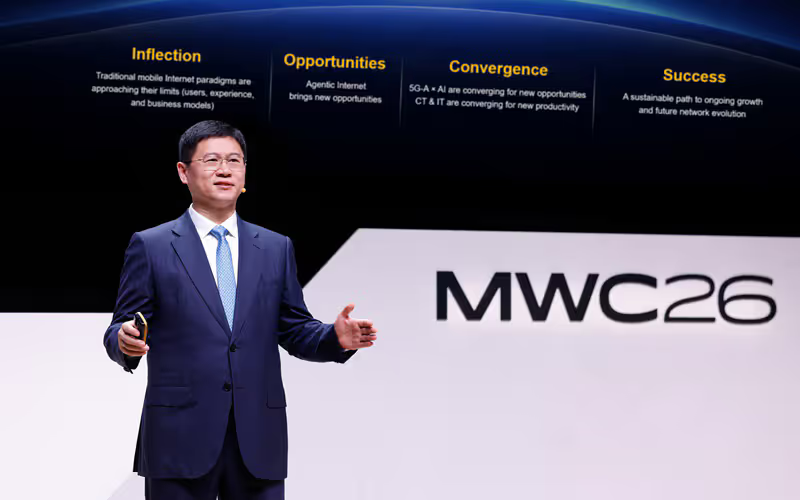
When telecom giants talk about AI, it is no longer about experiments. It is about survival. At the Huawei Cloud Summit at MWC26, Huawei made one message clear: AI is moving from hype to infrastructure.
Held during Mobile World Congress 2026, the Huawei Cloud Summit at MWC26 brought together telecom operators, enterprise leaders, and developers to explore how AI can solve real industry bottlenecks. From network optimization to smarter manufacturing, the focus was practical deployment, not theory.
According to Huawei Cloud, industries are entering a phase where large models and AI-native cloud architecture are becoming foundational. The conversation has shifted from whether to adopt AI to how fast it can scale responsibly.
Huawei Cloud Summit at MWC26: AI for Real-World Industry Problems
The core theme of the Huawei Cloud Summit at MWC26 was solving industry challenges with AI-driven cloud infrastructure. Huawei showcased solutions designed for telecom, finance, government, and manufacturing sectors.
Telecom operators, for example, are under pressure to manage rising data traffic while reducing operational costs. Huawei highlighted AI-powered network automation tools that aim to improve fault detection and predictive maintenance. Industry analysts such as GSMA have previously reported that AI-driven automation can reduce network operational expenses by up to 30 percent in certain deployments.
Huawei Cloud also emphasized its ModelArts platform, designed to streamline AI development and deployment. By integrating large models with industry-specific datasets, enterprises can customize AI systems without building everything from scratch.
Building AI-Native Cloud Infrastructure
A major takeaway from the Huawei Cloud Summit at MWC26 was the push toward AI-native cloud architecture. Instead of layering AI onto legacy systems, Huawei is advocating for infrastructure built specifically for large-scale AI workloads.
This includes high-performance computing resources, distributed storage, and optimized data pipelines. As AI models grow in size and complexity, traditional cloud setups often struggle with latency and cost efficiency. Huawei’s approach aims to address these bottlenecks by aligning compute, storage, and networking more tightly.
The broader industry trend supports this shift. Research from McKinsey suggests that companies that integrate AI deeply into core workflows outperform peers in productivity and innovation metrics. However, integration requires robust infrastructure, not just algorithms.
Opportunities and Ethical Considerations
While the Huawei Cloud Summit at MWC26 focused on acceleration, it also acknowledged challenges.
Data privacy, model bias, and energy consumption remain pressing concerns. Large AI models demand significant computational power, raising sustainability questions. Regulators worldwide are tightening rules around AI governance, and enterprises must ensure compliance.
Huawei stressed secure-by-design architecture and compliance frameworks. Still, independent verification and transparency will remain critical for global trust, especially as geopolitical scrutiny around technology vendors intensifies.
AI is not a silver bullet. It amplifies both efficiency and risk.
What This Means for Businesses
For enterprises, the message is pragmatic. AI adoption must be industry-specific, measurable, and aligned with business outcomes.
Companies should assess three areas:
- Infrastructure readiness
- Data quality and governance
- Clear ROI metrics for AI deployments
The Huawei Cloud Summit at MWC26 signals that AI is becoming embedded in cloud strategy, not treated as an add-on. Businesses that prepare now will likely gain a competitive edge as AI-native systems become the standard.
Conclusion
The Huawei Cloud Summit at MWC26 reflects a broader shift in the global tech landscape. AI is no longer experimental. It is operational.
The real question is not whether AI will transform industries. It is which organizations will build the right foundations to scale it responsibly and profitably.
As AI-native cloud infrastructure evolves, enterprises must balance speed with ethics, innovation with compliance, and ambition with accountability.
Fast Facts: Huawei Cloud Summit at MWC26 Explained
What is MWC26?
MWC26 (Mobile World Congress Barcelona) is the world’s largest mobile and connectivity trade show, organized by GSMA, held March 2–5 2026 at Fira de Barcelona, Spain. It brings together telecom operators, device makers, tech companies and media to showcase innovations in mobile technologies.
What did Huawei showcase at MWC26?
Huawei unveiled several key technologies, including an Agentic Core solution to accelerate AI-driven networks, an AI-Native framework for intelligent operations, and 5G-Advanced-oriented network architectures designed to support large-scale AI agent connectivity and autonomous networks.
How does the Huawei Cloud Summit at MWC26 impact businesses?
The Huawei Cloud Summit at MWC26 highlights AI-native cloud infrastructure that helps businesses automate operations, reduce costs, and scale large AI models more efficiently.