Indian Government Evaluating Framework for Regulating AI Training Data Sources
India is moving toward regulating how AI models are trained. The proposed framework could reshape data access, innovation, and accountability across the country’s fast-growing AI ecosystem.
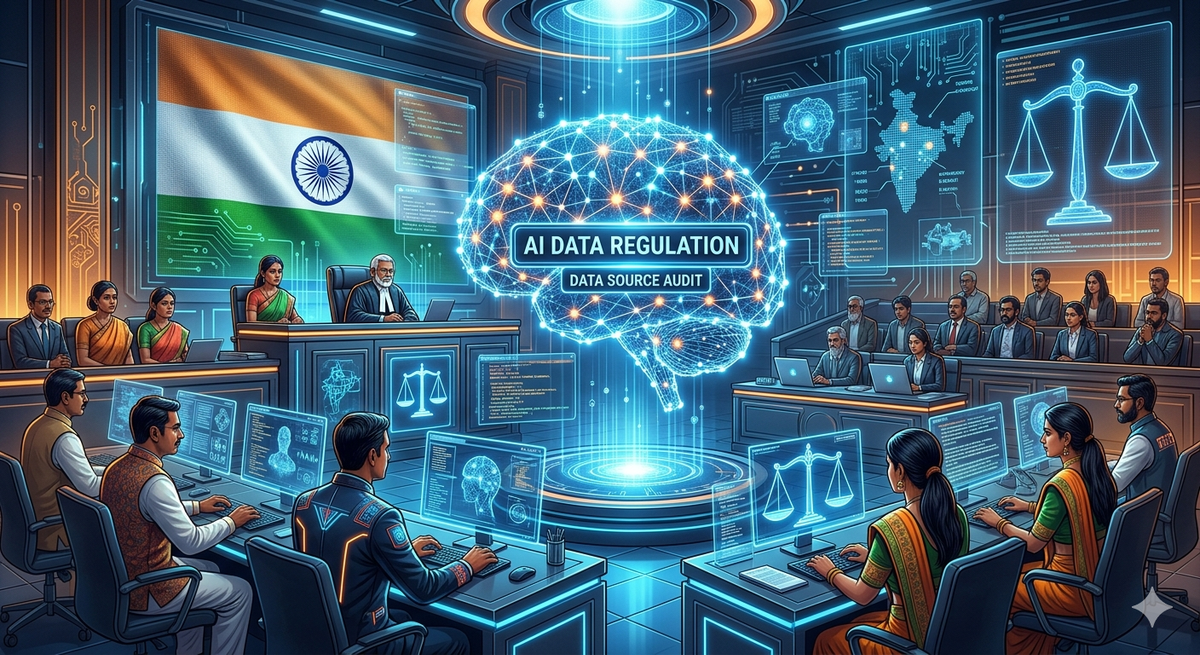
Who controls the data that fuels artificial intelligence is no longer a theoretical debate. It is becoming policy. The Indian government evaluating framework for regulating AI training data sources signals a decisive shift toward accountability in one of the fastest-growing tech ecosystems in the world.
India’s Ministry of Electronics and Information Technology is actively exploring guidelines that could define how companies collect, process, and use datasets to train AI models. This move aligns India with global scrutiny surrounding data practices used by major AI developers like OpenAI and Google, where questions about data sourcing, consent, and ownership are intensifying.
Why Regulating AI Training Data Matters
Artificial intelligence systems depend entirely on the quality and legality of their training data. Yet much of this data is scraped from the internet, often without explicit permission from creators or individuals.
The Indian government evaluating framework for regulating AI training data sources aims to address several risks. These include privacy violations, misuse of copyrighted content, algorithmic bias, and the lack of transparency in how models are built. Without clear rules, AI systems can amplify misinformation, replicate harmful stereotypes, or expose sensitive data.
Indian Government Evaluating Framework for Regulating AI Training Data Sources
Early discussions suggest the framework will introduce stricter compliance requirements for AI developers. Companies may be required to disclose the origin of their training data, ensure user consent where applicable, and establish mechanisms to handle legal disputes over content usage.
There is also likely to be a focus on defining how copyrighted material can be used in training datasets. This is a major concern globally, as creators push back against unauthorized use of their work in AI systems.
Balancing Innovation with Oversight
India faces a complex challenge. The country’s AI sector is expanding rapidly, with projections from NASSCOM estimating the market could reach $7.8 billion by 2025. Overregulation could slow this growth, especially for startups that lack the resources to navigate complex compliance systems.
At the same time, weak oversight risks undermining public trust. The Indian government evaluating framework for regulating AI training data sources appears to be designed as a middle path. It seeks to protect users while maintaining an environment that supports innovation.
Implications for Businesses and Developers
If implemented, the framework will reshape how AI systems are built and deployed in India. Developers will need to audit datasets, improve documentation, and ensure transparency in model training processes.
Businesses relying on AI tools may also face new compliance requirements. This includes verifying whether the tools they use adhere to data governance standards set by regulators.
For global companies operating in India, alignment with these rules will become essential. Non-compliance could lead to legal challenges or restrictions in one of the world’s largest digital markets.
Conclusion
The Indian government evaluating framework for regulating AI training data sources marks a critical step toward responsible AI governance. It reflects a broader global trend of tightening oversight on how artificial intelligence systems are trained.
The outcome will depend on execution. Effective regulation could position India as a leader in ethical AI development. Poorly designed rules could slow innovation and create uncertainty for businesses. The balance between control and creativity will define the next phase of India’s AI journey.
Fast Facts: Indian government evaluating framework for regulating AI training data sources Explained
What is this framework about?
The Indian government evaluating framework for regulating AI training data sources focuses on setting rules for how data is collected and used to train AI systems, ensuring transparency and accountability.
Why is this important now?
The Indian government evaluating framework for regulating AI training data sources responds to rising concerns about privacy, bias, and unauthorized use of copyrighted data in AI development.
What challenges could arise?
The Indian government evaluating framework for regulating AI training data sources could slow innovation if too strict, or fail to protect users if regulations are too weak.