Meta quietly scaling down metaverse investments to refocus on AI products
Meta is shifting billions from its metaverse ambitions toward AI, signaling a strategic reset as competition in generative AI intensifies and real-world returns from virtual worlds lag expectations.
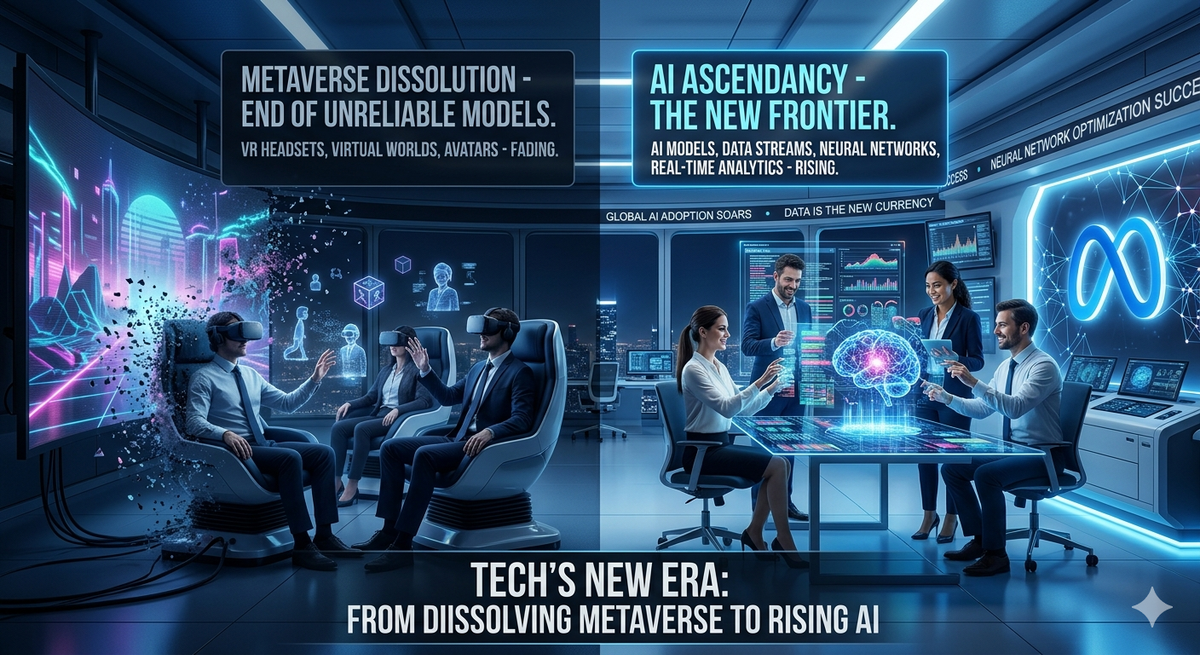
What happens when one of the world’s boldest tech bets fails to deliver fast enough? You shift gears. Meta is doing exactly that, quietly scaling back its metaverse spending while pushing aggressively into artificial intelligence.
The move is not loud or dramatic, but the signals are clear. Financial disclosures, hiring trends, and product rollouts all point to a company recalibrating its priorities toward AI, where growth and monetization look far more immediate.
Why Meta is rethinking its metaverse bet
Meta has poured tens of billions of dollars into its Reality Labs division since 2020. The goal was to build a fully immersive digital ecosystem powered by virtual and augmented reality. While the company made progress with devices like the Quest headset, mainstream adoption has been slower than expected.
Revenue from metaverse-related products has not matched the scale of investment. The gap between vision and real-world usage has raised concerns among investors, especially as losses from Reality Labs continue to grow.
Simply put, the metaverse is still a long-term idea. Investors want returns now.
Meta quietly scaling down metaverse investments to refocus on AI products
The shift toward AI is not just about cutting losses. It is about chasing opportunity. Generative AI has become the most competitive space in tech, with companies racing to build smarter, faster, and more useful tools.
Meta has accelerated development of its AI models, including LLaMA, and is embedding AI across its platforms. From Instagram to WhatsApp, users are already seeing features powered by machine learning, such as chat assistants, content generation, and smarter recommendations.
Leadership messaging reflects this shift. CEO Mark Zuckerberg has highlighted AI as a central focus, and hiring has increasingly targeted machine learning engineers and AI researchers.
How AI is reshaping Meta’s core business
AI directly strengthens Meta’s biggest revenue driver, advertising. Smarter algorithms improve targeting, automate creative production, and enhance campaign performance for businesses.
For users, this translates into more personalized feeds, AI-generated content, and interactive tools that make platforms more engaging. These are practical, widely used applications that scale quickly.
Compared to the metaverse, AI offers clearer use cases and faster returns. That makes it an easier bet in the current market.
Risks and trade-offs of the pivot
Scaling back metaverse investment carries long-term risks. Virtual and augmented reality are still seen as the future of computing. Slowing progress now could allow competitors to gain ground.
AI is not risk-free either. Regulatory pressure is increasing, especially around data use, misinformation, and transparency. The cost of training large AI models is also significant, and returns are not guaranteed.
There is also a strategic question. Meta rebranded itself around the metaverse. Shifting focus again raises concerns about consistency and long-term vision.
What this means going forward
Meta is not abandoning the metaverse. It is prioritizing AI as the near-term growth engine while keeping its long-term ambitions intact.
This balanced approach reflects a broader industry trend. Tech companies are investing in AI for immediate gains while maintaining future-facing projects with tighter budgets.
For users, the impact is already visible. Expect more AI-driven features in everyday apps and a slower, more measured evolution of virtual worlds.
Meta’s strategy is a reminder that in tech, timing matters as much as vision. Right now, AI is where the momentum is. The metaverse may still matter, but it can wait.
Fast Facts: Meta quietly scaling down metaverse investments to refocus on AI products Explained
What does this shift actually mean?
Meta quietly scaling down metaverse investments to refocus on AI products means shifting money and talent toward AI tools that deliver faster results and broader adoption.
Why is Meta prioritizing AI over the metaverse?
Meta quietly scaling down metaverse investments to refocus on AI products reflects stronger demand, clearer monetization, and pressure to show near-term financial performance.
Is the metaverse strategy over?
Meta quietly scaling down metaverse investments to refocus on AI products does not end its metaverse plans. It simply delays them while AI takes priority.