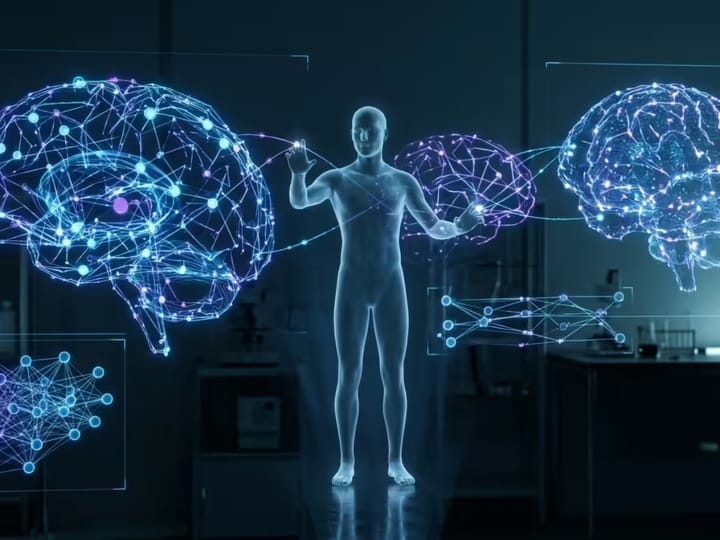
Mind Meets Machine: How AI Is Decoding the Brain and Redefining Human–Computer Interfaces
Explore how AI is decoding the brain to advance neuroscience and human-computer interfaces, from medical breakthroughs to ethical challenges shaping the future.

Artificial intelligence is quietly crossing one of the most profound frontiers in science: the human brain. What once required decades of manual analysis can now be processed in hours, sometimes minutes. According to research highlighted by MIT Technology Review and Nature Neuroscience, AI systems are learning to decode neural signals with a level of accuracy that was unthinkable just a decade ago.
This progress is not about mind reading in a science fiction sense. It is about pattern recognition at scale. AI models can analyze vast streams of brain data and identify relationships between neural activity, behavior, and intention. The implications span neuroscience, medicine, and human-computer interaction, opening doors to therapies and interfaces that feel almost intuitive.
From Raw Neural Data to Meaningful Signals
The human brain produces enormous volumes of data. A single second of neural activity captured through EEG, fMRI, or implanted electrodes can generate thousands of data points. Traditionally, interpreting this data required expert-led statistical analysis, often limited in scope.
AI has changed that equation. Deep learning models excel at finding patterns in complex, noisy datasets. Researchers now use AI to map neural activity to specific actions, images, or words. In 2023, a University of Texas team used AI to reconstruct continuous language from brain scans, demonstrating how neural signals can be translated into coherent text.
This shift allows neuroscientists to move beyond correlation and toward prediction. AI does not just observe what the brain is doing. It anticipates what the brain is about to do, which is critical for real-time applications.
Breakthroughs in Brain-Computer Interfaces
Brain-computer interfaces, or BCIs, sit at the intersection of AI and neuroscience. These systems enable direct communication between the brain and external devices. Early BCIs were slow and unreliable. AI has dramatically improved their performance.
Companies like Neuralink and academic groups at Stanford and EPFL use machine learning to decode motor intentions from neural signals. In clinical trials, paralyzed patients have used AI-powered BCIs to type text, control robotic arms, and even generate speech at near conversational speeds.
Beyond medical use, non-invasive BCIs are gaining attention for gaming, accessibility, and productivity. AI makes these interfaces adaptive, learning each user’s neural patterns over time. The result is a system that feels less like a tool and more like an extension of the body.
Transforming Neuroscience Research and Mental Health
AI is also reshaping how scientists understand the brain itself. In neuroscience research, AI models help identify biomarkers for conditions such as Alzheimer’s, depression, and epilepsy. By analyzing brain scans alongside genetic and behavioral data, AI uncovers patterns that human researchers might miss.
In mental health, this capability is especially promising. AI-driven analysis of neural signals and speech patterns can support earlier diagnosis and personalized treatment. Some research groups are exploring AI systems that adjust neurostimulation therapies in real time, based on brain activity.
However, experts caution that these systems are decision-support tools, not replacements for clinicians. The complexity of the human brain demands careful interpretation and validation.
Ethical and Technical Challenges
Decoding the brain raises serious ethical questions. Neural data is deeply personal. Unlike a password, it cannot be changed. Concerns around consent, data ownership, and surveillance are already being debated by policymakers and ethicists.
There are also technical limitations. Brain data varies widely between individuals. Models trained on small or biased datasets may not generalize well. Errors in interpretation could have significant consequences in medical or legal contexts.
Organizations like the OECD and IEEE are working on guidelines for responsible neurotechnology. Transparency, human oversight, and strict data governance are emerging as non-negotiable principles.
What Comes Next for Human–Computer Interaction
As AI decoding improves, human-computer interfaces may become less visible and more intuitive. Instead of keyboards and touchscreens, interaction could rely on subtle neural signals and intent recognition. This shift could redefine accessibility, enabling people with disabilities to interact with digital systems effortlessly.
For the broader public, adoption will likely be gradual. Trust, regulation, and clear benefits will determine how far these technologies go. The trajectory suggests augmentation rather than replacement, with AI enhancing human capability rather than overriding it.
Conclusion
AI is not unlocking the brain all at once. It is decoding it layer by layer, pattern by pattern. The convergence of neuroscience and artificial intelligence is already transforming medicine and interaction design, while forcing society to confront new ethical realities.
The next decade will determine whether these technologies remain niche medical tools or become foundational to how humans and machines coexist. What is clear is that the brain is no longer an unreachable black box. With AI, it is becoming a readable, interpretable, and profoundly influential frontier.
Fast Facts: How AI Is Decoding the Brain Explained
What does it mean when people say AI is decoding the brain?
AI decoding the brain refers to using machine learning models to interpret neural signals and link them to thoughts, actions, or intentions in a structured, measurable way.
What can AI decoding the brain do today in real life?
AI decoding the brain already enables speech generation for paralyzed patients, early disease detection, and adaptive brain-computer interfaces in medical and research settings.
What are the main limits and risks of AI decoding the brain?
AI decoding the brain faces challenges around data privacy, individual variability, and ethical misuse. Misinterpretation of neural data and lack of regulation remain serious concerns.
ChatGPT can make mistakes. Check important info. See Cookie Preferences.