North Korea Integrates AI Across Cyber, Economic and Military Domains
As sanctions tighten and isolation deepens, North Korea’s integration of AI is quietly reshaping its cyber power, economic resilience, and military calculus.
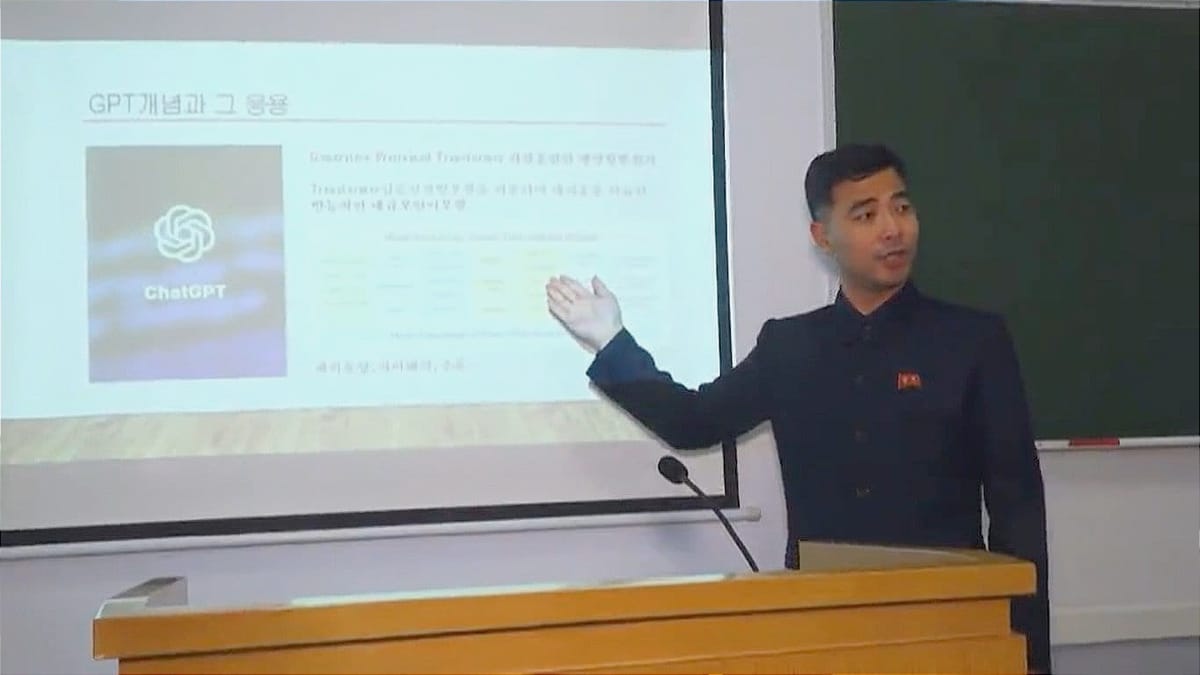
What happens when one of the world’s most isolated states accelerates its push into artificial intelligence? According to a recent analysis by 38 North, North Korea's integration of AI is no longer theoretical. It is unfolding across cyber operations, economic planning, and military modernization with growing sophistication.
While global powers race to develop frontier AI models, Pyongyang appears focused on applied AI that strengthens regime survival, enhances asymmetric capabilities, and offsets structural weaknesses.
AI in Cyber Operations: A Force Multiplier
One of the clearest signals of North Korea's integration of AI is in its cyber domain. North Korean hacking groups, long linked by the United Nations and cybersecurity firms to cryptocurrency theft and espionage campaigns, are believed to be exploring AI-enabled automation.
AI tools can assist with phishing customization, vulnerability discovery, malware adaptation, and large-scale data analysis. This lowers operational costs and increases efficiency. According to multiple cybersecurity reports cited by 38 North, automation and machine learning are increasingly embedded in global cybercrime ecosystems, and North Korea is unlikely to lag behind.
For a sanctions-constrained economy, AI-enhanced cyber operations offer a high return on investment with relatively low physical risk.
North Korea's Integration of AI in Economic Planning
Beyond cybercrime, North Korea's integration of AI extends into domestic economic management. State media has highlighted research institutes focused on artificial intelligence, data science, and industrial automation.
AI applications in logistics optimization, agricultural forecasting, and manufacturing efficiency can help mitigate chronic resource shortages. While the country lacks access to cutting-edge semiconductor infrastructure, applied AI systems do not always require frontier hardware.
However, limitations remain significant. International sanctions restrict access to advanced chips and training datasets. This constrains the scale and performance of AI deployments compared to leading economies.
Military Modernization and Autonomous Systems
The military implications are more concerning. AI integration into surveillance systems, missile guidance optimization, and autonomous platforms could enhance North Korea’s strategic deterrent.
The 38 North analysis suggests that AI could improve targeting precision, intelligence analysis, and battlefield awareness. Even incremental gains in these areas can shift risk calculations on the Korean Peninsula.
At the same time, North Korea’s technological ecosystem is not self-sufficient. AI models depend on data, compute, and research collaboration. Isolation limits access to global innovation networks.
Ethical and Strategic Risks
North Korea's integration of AI raises broader ethical and geopolitical concerns. AI-enabled cyber theft, misinformation campaigns, or autonomous weapons development could amplify instability.
Yet it is important to avoid exaggeration. North Korea is not currently a global AI leader comparable to the United States or China. Its AI strategy appears pragmatic rather than revolutionary.
The larger lesson is structural. AI lowers barriers to entry for states that rely on asymmetric tactics. That trend challenges traditional deterrence models and complicates international governance efforts.
What This Means Going Forward
North Korea's integration of AI reflects a broader reality. Artificial intelligence is becoming a general-purpose technology that even heavily sanctioned states can adapt.
For policymakers, this means investing in cyber resilience, export controls on advanced chips, and coordinated AI governance. For businesses, especially in cybersecurity and defense, it signals rising demand for AI-driven threat detection.
The AI race is not just about scale. It is about application.
Fast Facts: North Korea's Integration of AI Explained
Does North Korea have AI?
Yes, North Korea has integrated artificial intelligence across several domains, primarily focusing on military and cyber operations to bypass international sanctions. Leader Kim Jong Un has designated AI-enabled systems as a top-priority for modernising the country's armed forces.
How is North Korea integrating AI in practice?
North Korea's integration of AI is most visible in cyber activities, data analysis, automation, and potential military targeting improvements, offering efficiency gains without requiring massive infrastructure.
What limits North Korea's integration of AI?
North Korea's integration of AI is constrained by sanctions, limited access to advanced semiconductors, restricted datasets, and isolation from global research networks, which slows large-scale innovation.