The $1 Trillion AI Infrastructure Boom: How Chips, Data Centers, and Cloud Are Reshaping Global Computing
Explore the booming AI infrastructure market: from NVIDIA's GPU dominance to data center buildouts, power crises, and the $7 trillion race reshaping tech.

The world's largest technology companies are in the middle of a trillion-dollar spending spree, and it's reshaping everything from Silicon Valley to small towns in rural America. In 2024, hyperscalers like Google, Microsoft, Amazon, and Meta collectively invested nearly $200 billion in AI infrastructure.
By 2025, that figure is projected to exceed $370 billion, a staggering 44% year-over-year increase. This isn't just another tech cycle. It's the largest infrastructure build-out since the internet itself.
The global AI infrastructure market is racing toward the trillion-dollar threshold. Data center equipment and infrastructure spending reached $290 billion in 2024, with projections to exceed $1 trillion annually by 2030.
But this headline-grabbing figure masks a deeper, more complex story: the intensifying competition for specialized hardware, the rise of alternative chip architectures, the power crisis looming on the horizon, and the race by nations to maintain technological sovereignty. Understanding this ecosystem is crucial for investors, technologists, and anyone trying to make sense of where AI is actually heading.
The GPU Dominance that's About to Face Real Competition
Graphics processing units have been the workhorses of AI since the deep learning revolution of the 2010s. NVIDIA captured 93% of server GPU revenue in 2024, with GPU revenue projected to grow from $100 billion to $215 billion by 2030. This near-monopoly gave NVIDIA an astronomical market cap of $4 trillion, more than most countries' GDPs.
But NVIDIA's grip is beginning to feel pressure from multiple directions. Custom AI accelerators (ASICs) built by hyperscalers for their own proprietary models are gaining traction. Google's TPUs, Tesla's Dojo chips, and Meta's custom inference accelerators represent a strategic shift: instead of relying on third-party hardware suppliers, cloud giants are vertically integrating. AI ASICs are growing rapidly and will reach almost $85 billion by 2030 as hyperscalers pursue vertical integration and cost control.
Startup companies like Cerebras, Groq, and Tenstorrent are also disrupting the market with novel architectures optimized for specific workloads. Groq's deterministic inference engines, for example, achieve remarkable speed with lower power consumption.
While these challengers don't yet threaten NVIDIA's dominance in training workloads, they're carving out valuable niches in inference, where latency and cost per inference become critical.
The real vulnerability for NVIDIA, however, isn't just competition. It's geopolitics. Chinese chipmakers are rapidly advancing their own AI accelerators, spurred by export restrictions and government backing. This dual-track development means the global AI chip market is fragmenting, and NVIDIA's 93% market share will inevitably face pressure as regional players develop capabilities.
The Data Center Infrastructure Race: Building Faster Than Ever
While chips capture headlines, the unsexy world of data center infrastructure is where the real action is happening. Servers represent approximately 63% of total data center investment in 2024, with the server market projected to grow from $204 billion to nearly $1 trillion by 2030.
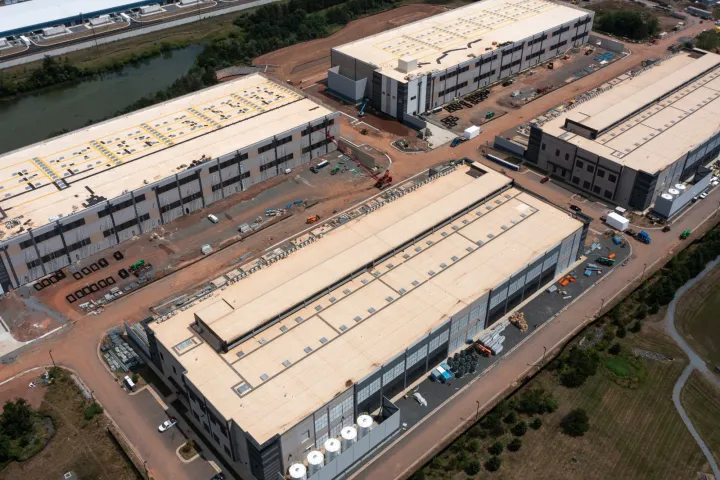
But building new capacity isn't straightforward. A major AI data center can take three to four years to construct, compete for scarce power resources, and cost billions of dollars.
The urgency is real. In Northern Virginia, the data capital of the world, the vacancy rate for data center space was less than 1% in 2024. New capacity is already fully leased before completion. This scarcity is driving rental prices up and pushing hyperscalers to expand into new geographies, from Iowa and Indiana to remote locations globally.
Cloud service providers are deploying a multipronged strategy to accelerate deployment. Modular "rack-scale" systems, pre-configured bundles of servers, storage, and networking optimized for AI workloads, are becoming standard. Supermicro's Data Center Building Block Solutions exemplify this trend. These validated, integrated racks allow companies to deploy compute faster without custom engineering.
Meanwhile, a new class of specialized providers is emerging. GPU cloud providers like CoreWeave operate independent data centers equipped with AI-optimized infrastructure. CoreWeave had approximately 45,000 GPUs by July 2024 and aimed to operate in 28 locations globally by year-end.
These providers offer GPUs as a service, appealing to startups and enterprises that can't afford to build their own megafacilities. Colocation providers, traditionally focused on enterprise hosting, are now the second-largest AI data center operators after hyperscalers themselves.
Power, Cooling, and the Energy Crisis That's Become Impossible to Ignore
Here's the uncomfortable truth: artificial intelligence is thirsty. Incredibly thirsty. Data centers worldwide consumed approximately 415 TWh of electricity in 2024, about 1.5% of global usage, with projections that AI-specific data center electricity demand could quadruple by 2030 if current trends continue. To put that in perspective, a single large AI training cluster consumes as much power as 100,000 homes.
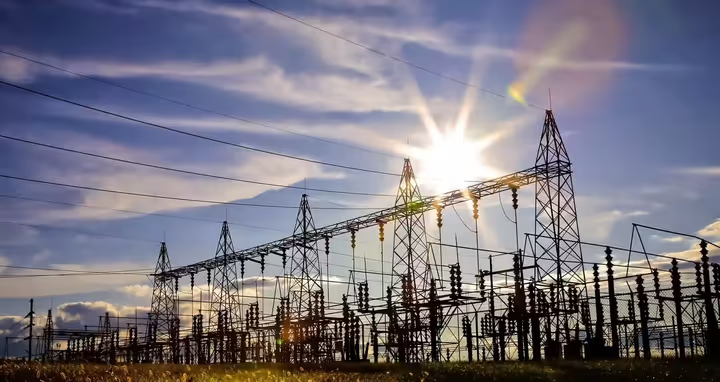
Power is now the primary constraint on data center expansion. Electric and gas utilities are forecasting a 22% year-over-year jump in capital expenditure to $212 billion in 2025, and cumulative utility capex is expected to surpass $1 trillion over the next five years. But there's a catch: traditional power grids can't scale fast enough. It takes four or more years to build new transmission lines, even before constructing a power plant.
This has created a scramble for alternative energy sources. Nuclear power is emerging as the dark horse. Multiple nuclear power purchase agreements were signed in 2024 involving active nuclear plants as well as decommissioned plants slated for reactivation around 2028.
Companies like Amazon and other hyperscalers are acquiring data centers built next to nuclear facilities to guarantee reliable, carbon-free power. Small modular reactors (SMRs) represent another avenue, with announcements expected to double in 2025.
Renewable energy, geothermal power, and even hydrogen fuel cells are being deployed. But the reality is that scaling renewable infrastructure is also time-consuming and geographically constrained. This energy gap is forcing some hyperscalers to consider colocation data centers in regions with abundant cheap power, even if latency for inference becomes slightly higher.
On the cooling front, liquid cooling technology is transitioning from experimental to essential. A hybrid approach with 70% liquid cooling and 30% air cooling has quickly become the default installation in new data center construction.
Direct-to-chip (DTC) liquid cooling, which routes coolant directly to processors, can handle 60 to 120 kW per rack. For extreme densities, immersion cooling (submerging servers in dielectric fluid) is emerging as the next step, though it's still niche, affecting less than 10% of data centers today.
Memory, Networking, and the Semiconductor Supply Chain Transformation
Behind every AI breakthrough is a dense network of supporting semiconductor components. While GPUs dominate conversations, memory and networking chips are equally critical and experiencing rapid innovation.
DDR5, HBM, and CXL solutions are increasing in use to address memory bandwidth and capacity challenges in AI workloads. High bandwidth memory (HBM) is particularly crucial for training large language models, and demand is exploding.
The semiconductor market itself is consolidating around AI requirements. The total semiconductor market for data centers is projected to grow from $209 billion in 2024 to $492 billion by 2030. This growth extends beyond GPUs. Custom networking chips, power management ICs, and emerging optical interconnect technologies (photonics) are all accelerating.
One often-overlooked aspect: manufacturing capacity. Advanced semiconductor production is concentrated in just a handful of locations, primarily Taiwan and South Korea. Export restrictions imposed by the US targeting advanced Chinese chip capabilities have created a geopolitical dimension to the infrastructure race. Nations are now incentivizing onshore chip manufacturing, though building a cutting-edge fab takes five years and costs $10+ billion.
The Cloud War Meets the AI Imperative
The competitive dynamics are fundamentally shifting. A decade ago, the race was for cloud market share. Today, it's a race for AI infrastructure dominance. Amazon, Microsoft, Google, and Meta are locked in a battle to provide not just computing capacity, but end-to-end AI solutions, from chips and data centers to cloud platforms and AI services.
Microsoft's partnership with OpenAI, reflected in aggressive Azure data center expansion, represents a bet-the-company strategy. Google is defending its position against cloud rivals while managing its own AI ambitions.
Amazon is diversifying, building infrastructure for both its own AI initiatives and third-party customers through AWS. Meta is perhaps taking the boldest approach, building custom chips and competing directly in the cloud space.
But hyperscalers don't have unlimited capital. Of the projected $1 trillion in data center infrastructure spending, Alphabet, Microsoft, Amazon, and Meta are expected to significantly increase their CapEx beyond the $200 billion they invested in 2024. This massive spending comes with board-level pressure to demonstrate ROI, making the efficiency of new infrastructure critical.
The Geopolitical Stakes Are Unprecedented
The AI infrastructure race is, at its core, a contest for technological and economic supremacy. China, Japan, South Korea, and India are investing heavily in AI infrastructure, hyperscale data centers, and AI chip development, with Asia Pacific emerging as the fastest-growing region. China's AI Development Plan through 2030 explicitly targets supercomputing capabilities and domestic semiconductor leadership.
This geographical dimension means the infrastructure boom isn't uniform. The US maintains advantages in chip design and cloud infrastructure, but Asia is rapidly closing the gap. Europe is betting on sovereign AI infrastructure, attempting to create independent capacity rather than relying on American cloud giants. This fragmentation, while creating redundancy, also increases total infrastructure costs.
What's Next: Efficiency, Sustainability, and the Next Bottleneck
The near-term trajectory is clear: hyperscalers will continue their spending spree, reaching $370+ billion in 2025 and beyond. Power constraints will ease somewhat as new generation capacity comes online, but it will remain the primary limiting factor. Competition in specialized chips will intensify, though NVIDIA will likely maintain significant dominance for training workloads.
The next critical frontier is efficiency. DeepSeek's recent V3 model demonstrated that with clever algorithmic improvements, AI training costs can drop dramatically. DeepSeek reported its V3 model achieved an approximately 18-fold reduction in training costs and 36-fold reduction in inferencing costs compared with GPT-4o.
This suggests that infrastructure spending alone won't determine AI dominance. Efficiency in model design and algorithmic breakthroughs will matter as much as raw hardware.
The AI infrastructure market is no longer a speculative sector. It's the foundation upon which the entire next era of computing will be built. The scale of investment, the complexity of challenges, and the geopolitical dimensions make it one of the most consequential industrial transformations of our time.
Whether you're an investor seeking the next opportunity, a technologist understanding industry direction, or a business leader preparing for an AI-augmented future, the infrastructure story is the story to watch.
Fast Facts: AI Infrastructure Boom Explained
What exactly is AI infrastructure, and why is it so critical?
AI infrastructure encompasses the data centers, semiconductors, networking equipment, and power systems required to train and deploy large-scale AI models. It's critical because without robust infrastructure, advancing AI capabilities becomes impossible; infrastructure literally sets the ceiling for AI development speed and scale.
How much is NVIDIA dominating the AI chip market, and will that change?
NVIDIA captured 93% of server GPU revenue in 2024. While custom ASICs from hyperscalers and startup competitors are emerging, NVIDIA's dominance will likely persist through 2030, though market share may gradually decline as alternatives mature.
What's the biggest constraint on data center expansion right now?
Power generation and transmission infrastructure is the primary bottleneck. Traditional electrical grids can't scale fast enough to meet AI data center demand, forcing companies to explore nuclear, renewable, and alternative energy sources while waiting for new transmission lines to be built.